Sunday, July 09, 2006
Regular readers
will know that I find it ridiculously easy to love a very large number of books and writers; but on a shortish list of writers I particularly, particularly love is Eva Ibbotson, and I have just read a truly delightful little piece she has written for the Guardian about loving public libraries--seriously, it is like something out of one of her novels, how lovely!


Saturday, July 08, 2006
At the Washington Post
Graham Joyce reviews Keith Donohue's The Stolen Child. I think I must get this one and read it--I picked it up off a table in a bookstore & looked at it because in theory it is exactly the kind of thing I love, but somehow the prose didn't catch me and I put it back down again. I wish Joyce had actually quoted something from the novel, I am still not quite convinced that this book is for me but I guess it's worth trying....
I have been reading
an evil genius: it is a ridiculous phrase, I realize, but sometimes it's the only thing that will do.
I always feel very strongly with certain books written hundreds of years ago that I am in the presence of very high-caliber intellectual force: I read widely across a lot of different kinds of eighteenth-century prose, for instance, and you can tell right away how clear and forceful (or not) the particular writer is going to be. Some of this is pretty much what you'd expect--there is something remarkably refreshing about reading Hume or Adam Smith or Godwin, there is such clarity and energy to their thought, and something similar goes for Burke who is always extraordinary. Some of it is disappointing: I recently read the very important and influential book by Hartley on the human mind and associationism and was disappointed to find it lacking that quality of power or freshness, and I was DYING to read a book by one Robert Wallace about population-related matters only it turned out to be not distinguished at all in its thinking, it was a great let-down. Then again there are some minor and little-known books of great force and freshness: some of these writers on agriculture, for instance, will really get to you. It doesn't have to be genius, by the way; it's more a question of voice.
The "evil genius" thing is a bit different. Partly I've been reading around proto-eugenics stuff, and in that sense lots of these eighteenth-century guys could be jokingly described as evil except that before the twentieth century it was often the on-the-whole-good-or-at-least-progressive-and-egalitarian guys (that's the horrible irony, of course) who liked to think about improving the human species in the same way you might improve a breed of cattle or manipulate the coupling of dogs in order to get healthier or more intelligent or more beautiful offspring. I'm not suggesting this is a good idea, not at all, but really, we can't go around holding these guys to account for things hardly within their imagining--or can we? This is some of what I get to write about in my chapter, I think--to what extent is the logic of extermination built into ambivalent-about-reproduction schemes of human perfectibility?
But some of the things you read from this period about racial difference will really turn your stomach. I have been making myself rather sick today, in an interesting way, with William Lawrence, who definitely falls (I don't talk this way when I'm lecturing, just in case you're worrying!) into the evil genius category. Evil, because what he says is so awful; genius, because it isn't dry and minor and irrelevant in the way you might expect of a now little-known early nineteenth-century book on human physiology full of thoroughly discredited and outmoded ideas, but rather lively and active and engaging in a way that makes his racial ideology all the more poisonous.
And yesterday I was reading and sort of half in love with Pierre-Jean-George Cabanis, he's got that same genius quality: in general the French medical-scientific stuff is a lot more flowery and rhetorical than its British counterparts, not always to good effect, but Cabanis manages to be rhetorical and supremely intellectual and engaging at the same time, it's quite excellent. His big book that I've been meaning to read for ages is Rapports du physique et du moral de l'homme but laziness about reading things in French meant I got hold of the really very good translation by Margaret Duggan Saidi, edited by George Mora: On the Relations Between the Physical and Moral Aspects of Man.
I have been working my way through it with equal parts enthrallment and horror. (It's a funny edition, Johns Hopkins UP from 1981 only really it's typed--offset printing, maybe? I'm not good on those technical details, but it's more like a xerox than a book--rather than properly typeset, and it says "Translated under the Special Foreign Currency Program of the National Library of Medicine. . . by the Agence Tunisienne de Public-Relations, Tunis, Tunisia, 1975." There's a story in this somewhere, but not one I can deduce from the available evidence....)
So why evil? Cabanis doesn't have all the racial stuff that you see in Lawrence and some of his contemporaries. But it is the most sickening separate-sphere thing you have ever seen, he has mixed feelings about Rousseau for instance but loves what Rousseau has to say about Sophie's education in Emile. Here are two paragraphs that had me absolutely dying with horror:
If the evil destiny of women, or the baneful admiration of undiscerning friends, pushes them along a contrary path; if, not content with pleasing by the graces of a natural spirit, by pleasant talents, by that art of society they possess to an undoubtedly higher degree than do men, they wish to astound by feats of strength and join the triumph of science to gentler and surer victories, then almost all their charm vanishes. They cease to be what they are in making quite vain efforts to become what they wish to appear. And losing the charms without which the power of beauty itself is quite uncertain or fleeting, they acquire most often only the science of pedantry and ridicule. In general, erudite women know nothing well. They confuse and mingle all objects, all ideas. The moment their lively conception had seized certain parts they imagine that they understand everything. Difficulties rebuff them: their impatience overcomes them. Incapable of fixing their attention long enough on one thing, they cannot feel the lively and profound pleasures of a deep meditation. They are incapable even of this. They go rapidly from one subject to another and retain only partial, incomplete notions that almost always form the strangest combinations in their heads.
For the small number of women who can obtain true successes in these categories that are completely foreign to the faculties of their minds, things are perhaps even worse. In youth, in maturity, in old age, what will be the place of these ambiguous beings who are, properly speaking, of no sex? By what attraction can they engage the young man seeking a companion? What assistance can ill or aged parents await from them? What sweetness will they cast over the life of a husband? Will one see them descend from the heights of their genius to take care of their children, of their homes? All those very delicate relations that constitute the charm and ensure the happiness of the woman no longer exist. In wanting to extend her empire, she destroys it. In a word, the nature of things and experience also prove that if the weakness of the woman's muscles keeps her from descending into the gymnasium and the race-course, the qualities of her mind and the role she must play in life keep her perhaps even more forcefully from making a specatacle of herself in the school or in the Porch.
(What I really felt is that I have to go and get really muscley like a machine, a machine of the masculine type--but isn't it extraordinary that something written over two hundred years ago can stir me up like this? I told you he was an evil genius....)
I've been doing a tiny amount of light reading around the edges, some good stuff. First of all a quite wonderful and rather enigmatic novel by Pamela Dean; I ordered it used from Amazon ages ago and it finally came, Juniper, Gentian, and Rosemary. I loved it--there is just something magical about this woman's books--it is funny, they would make absolutely disastrous models for starting-out writers, she does all sorts of things that shouldn't work at all (like have pages and pages of summary of Shakespearean plays, and everyone talking in quotations from Shakespeare) and yet they totally do. My enjoyment of this one was augmented by my realization that the thirteen-year-old main character Gentian is pretty much frighteningly exactly like I was when I was thirteen--only of course in the enchanting world of Dean's novels they always have other friends who are just the same, reading Shakespeare and wanting to be Jane Goodall and all that sort of thing. And I read another battered Marion Zimmer Bradley paperback, two novellas one of which I'd unfortunately read before without remembering the name: The Planet Savers/The Sword of Aldones (it's got an absolutely fascinating author's afterword that provides a sort of mini-writerly-autobiography with truly horrifying insight into gender stuff from the 50s and 60s and the difficulty of making a career as a pulp novelist, really quite mesmerizingly interesting--I do like MZB's books so much, I know people think they're impossibly trashy and yet at her best--admittedly not in these particular novellas--she is quite wonderful!). And I've just finished another very good book I've been wanting to read for a while now, The Strange Adventures of Rangergirl by Tim Pratt. I would have liked a bit more character development for the protagonist, she is appealing but not quite there: there's a tiny bit of backstory that feels underdeveloped and sometimes I felt she was a cipher standing in where you really want someone very warm-blooded and engaging. But it's a great read, and he's a really good story-teller, I felt the sense of pace and plot and stuff were all remarkably accomplished. I will look for his next novel with eagerness, definitely someone to watch out for.
I always feel very strongly with certain books written hundreds of years ago that I am in the presence of very high-caliber intellectual force: I read widely across a lot of different kinds of eighteenth-century prose, for instance, and you can tell right away how clear and forceful (or not) the particular writer is going to be. Some of this is pretty much what you'd expect--there is something remarkably refreshing about reading Hume or Adam Smith or Godwin, there is such clarity and energy to their thought, and something similar goes for Burke who is always extraordinary. Some of it is disappointing: I recently read the very important and influential book by Hartley on the human mind and associationism and was disappointed to find it lacking that quality of power or freshness, and I was DYING to read a book by one Robert Wallace about population-related matters only it turned out to be not distinguished at all in its thinking, it was a great let-down. Then again there are some minor and little-known books of great force and freshness: some of these writers on agriculture, for instance, will really get to you. It doesn't have to be genius, by the way; it's more a question of voice.
The "evil genius" thing is a bit different. Partly I've been reading around proto-eugenics stuff, and in that sense lots of these eighteenth-century guys could be jokingly described as evil except that before the twentieth century it was often the on-the-whole-good-or-at-least-progressive-and-egalitarian guys (that's the horrible irony, of course) who liked to think about improving the human species in the same way you might improve a breed of cattle or manipulate the coupling of dogs in order to get healthier or more intelligent or more beautiful offspring. I'm not suggesting this is a good idea, not at all, but really, we can't go around holding these guys to account for things hardly within their imagining--or can we? This is some of what I get to write about in my chapter, I think--to what extent is the logic of extermination built into ambivalent-about-reproduction schemes of human perfectibility?
But some of the things you read from this period about racial difference will really turn your stomach. I have been making myself rather sick today, in an interesting way, with William Lawrence, who definitely falls (I don't talk this way when I'm lecturing, just in case you're worrying!) into the evil genius category. Evil, because what he says is so awful; genius, because it isn't dry and minor and irrelevant in the way you might expect of a now little-known early nineteenth-century book on human physiology full of thoroughly discredited and outmoded ideas, but rather lively and active and engaging in a way that makes his racial ideology all the more poisonous.
And yesterday I was reading and sort of half in love with Pierre-Jean-George Cabanis, he's got that same genius quality: in general the French medical-scientific stuff is a lot more flowery and rhetorical than its British counterparts, not always to good effect, but Cabanis manages to be rhetorical and supremely intellectual and engaging at the same time, it's quite excellent. His big book that I've been meaning to read for ages is Rapports du physique et du moral de l'homme but laziness about reading things in French meant I got hold of the really very good translation by Margaret Duggan Saidi, edited by George Mora: On the Relations Between the Physical and Moral Aspects of Man.
I have been working my way through it with equal parts enthrallment and horror. (It's a funny edition, Johns Hopkins UP from 1981 only really it's typed--offset printing, maybe? I'm not good on those technical details, but it's more like a xerox than a book--rather than properly typeset, and it says "Translated under the Special Foreign Currency Program of the National Library of Medicine. . . by the Agence Tunisienne de Public-Relations, Tunis, Tunisia, 1975." There's a story in this somewhere, but not one I can deduce from the available evidence....)
So why evil? Cabanis doesn't have all the racial stuff that you see in Lawrence and some of his contemporaries. But it is the most sickening separate-sphere thing you have ever seen, he has mixed feelings about Rousseau for instance but loves what Rousseau has to say about Sophie's education in Emile. Here are two paragraphs that had me absolutely dying with horror:
If the evil destiny of women, or the baneful admiration of undiscerning friends, pushes them along a contrary path; if, not content with pleasing by the graces of a natural spirit, by pleasant talents, by that art of society they possess to an undoubtedly higher degree than do men, they wish to astound by feats of strength and join the triumph of science to gentler and surer victories, then almost all their charm vanishes. They cease to be what they are in making quite vain efforts to become what they wish to appear. And losing the charms without which the power of beauty itself is quite uncertain or fleeting, they acquire most often only the science of pedantry and ridicule. In general, erudite women know nothing well. They confuse and mingle all objects, all ideas. The moment their lively conception had seized certain parts they imagine that they understand everything. Difficulties rebuff them: their impatience overcomes them. Incapable of fixing their attention long enough on one thing, they cannot feel the lively and profound pleasures of a deep meditation. They are incapable even of this. They go rapidly from one subject to another and retain only partial, incomplete notions that almost always form the strangest combinations in their heads.
For the small number of women who can obtain true successes in these categories that are completely foreign to the faculties of their minds, things are perhaps even worse. In youth, in maturity, in old age, what will be the place of these ambiguous beings who are, properly speaking, of no sex? By what attraction can they engage the young man seeking a companion? What assistance can ill or aged parents await from them? What sweetness will they cast over the life of a husband? Will one see them descend from the heights of their genius to take care of their children, of their homes? All those very delicate relations that constitute the charm and ensure the happiness of the woman no longer exist. In wanting to extend her empire, she destroys it. In a word, the nature of things and experience also prove that if the weakness of the woman's muscles keeps her from descending into the gymnasium and the race-course, the qualities of her mind and the role she must play in life keep her perhaps even more forcefully from making a specatacle of herself in the school or in the Porch.
(What I really felt is that I have to go and get really muscley like a machine, a machine of the masculine type--but isn't it extraordinary that something written over two hundred years ago can stir me up like this? I told you he was an evil genius....)
I've been doing a tiny amount of light reading around the edges, some good stuff. First of all a quite wonderful and rather enigmatic novel by Pamela Dean; I ordered it used from Amazon ages ago and it finally came, Juniper, Gentian, and Rosemary. I loved it--there is just something magical about this woman's books--it is funny, they would make absolutely disastrous models for starting-out writers, she does all sorts of things that shouldn't work at all (like have pages and pages of summary of Shakespearean plays, and everyone talking in quotations from Shakespeare) and yet they totally do. My enjoyment of this one was augmented by my realization that the thirteen-year-old main character Gentian is pretty much frighteningly exactly like I was when I was thirteen--only of course in the enchanting world of Dean's novels they always have other friends who are just the same, reading Shakespeare and wanting to be Jane Goodall and all that sort of thing. And I read another battered Marion Zimmer Bradley paperback, two novellas one of which I'd unfortunately read before without remembering the name: The Planet Savers/The Sword of Aldones (it's got an absolutely fascinating author's afterword that provides a sort of mini-writerly-autobiography with truly horrifying insight into gender stuff from the 50s and 60s and the difficulty of making a career as a pulp novelist, really quite mesmerizingly interesting--I do like MZB's books so much, I know people think they're impossibly trashy and yet at her best--admittedly not in these particular novellas--she is quite wonderful!). And I've just finished another very good book I've been wanting to read for a while now, The Strange Adventures of Rangergirl by Tim Pratt. I would have liked a bit more character development for the protagonist, she is appealing but not quite there: there's a tiny bit of backstory that feels underdeveloped and sometimes I felt she was a cipher standing in where you really want someone very warm-blooded and engaging. But it's a great read, and he's a really good story-teller, I felt the sense of pace and plot and stuff were all remarkably accomplished. I will look for his next novel with eagerness, definitely someone to watch out for.
Friday, July 07, 2006
Pico Iyer at the Guardian
on the decline of the literary interview post-Google. It's cautionary, take a look if you're going to be interviewing an author any time soon....
A fine fleece and a fat carcass
From Harriet Ritvo's altogether wonderful book The Animal Estate : The English and Other Creatures in Victorian England, a list of some of the toasts offered at the banquet of the Holkham sheepshearing in 1810 (the original source is R. A. Parker's Coke of Norfolk, of which Amazon implausibly sets the shipping weight at 97 pounds--how agricultural!):
Constitution and King
The best use of the Plough
Prosperity to Agriculture
Breeding in all its Branches
A fine fleece and a fat carcass
Constitution and King
The best use of the Plough
Prosperity to Agriculture
Breeding in all its Branches
A fine fleece and a fat carcass
An invitation
Basically I am planning on being an insane recluse for the whole of July (I love it, that's my favorite thing--work and exercise only, plus a little light reading here and there), but the one event that's going to make me retreat from my lair and have human contact and a few drinks is the litblog-themed MetaxuCafe-hosted cocktail party tomorrow afternoon from four to six at the Jen Bekman gallery. If you are a regular reader of Light Reading, find me and say hello before I return to what my brother Jon Doe calls "living like a wild animal." (Actually because I am working at home, I never quite get that far--you can always do a load of laundry in the middle of the night--but I do feel a bit feral, in a good way.)
(Thanks to Galleycat for the link.)
(Thanks to Galleycat for the link.)
Thursday, July 06, 2006
Walking ashes, talking earth
I have just read a most extraordinary book--if you only read one book this year, it should be this one (did I already say that about something else recently? I expect so, but it doesn't stop me from meaning it again this time)--it is stomach-turning and heart-breaking and altogether quite the most disturbing thing I have read for a long time, Svetlana Alexievich's Voices From Chernobyl. (Here's the Complete Review's page with links to various other reviews, and here's the publicity page at Dalkey Archive Press.)
I am not even going to try to describe this one. Get it and read it, though. I thought quite a bit about this question of nuclear power this year because of being at the American Academy of Arts and Sciences, which is one of this country's prime movers for nonproliferation; one of my colleagues in the Visiting Scholars Program was working on the legacy of the Soviet Union's nuclear weapons complex, and we had many fascinating and disturbing conversations about this and related matters. This book would make a good reading assignment for one of those programs where they ask first-year college students all to read the same book for workshops as school starts; you couldn't ask high-school students to read it, I think, it's just too upsetting.
Anyway, here is the author in the book's coda (and the whole thing is very ably translated by Keith Gessen; it's a beautifully well-written book, Alexievich spent three years interviewing people and must have been almost overwhelmed with the volume of evidence but the material is astonishingly well-selected and assembled):
I used to think I could understand everything and express everything. Or almost everything. I remember when I was writing my book about the war in Afghanistan, Zinky Boys, I went to Afghanistan and they showed me some of the foreign weapons that had been captured from the Afghan fighters. I was amazed at how perfect their forms were, how perfectly a human thought had been expressed. There was an officer standing next to me and he said, "If someone were to step on this Italian mine that you say is so pretty it looks like a Christmas decoration, there would be nothing left of them but a bucket of meat. You'd have to scrape them off the ground with a spoon." When I sat down to write this, it was the first time I thought, "Is this something I should say?" I had been raised on great Russian ltierature, I thought you could go very very far, and so I wrote about that meat. But the Zone--it's a separate world, a world within the rest of the world--and it's more powerful than anything literature has to say.
I am not even going to try to describe this one. Get it and read it, though. I thought quite a bit about this question of nuclear power this year because of being at the American Academy of Arts and Sciences, which is one of this country's prime movers for nonproliferation; one of my colleagues in the Visiting Scholars Program was working on the legacy of the Soviet Union's nuclear weapons complex, and we had many fascinating and disturbing conversations about this and related matters. This book would make a good reading assignment for one of those programs where they ask first-year college students all to read the same book for workshops as school starts; you couldn't ask high-school students to read it, I think, it's just too upsetting.
Anyway, here is the author in the book's coda (and the whole thing is very ably translated by Keith Gessen; it's a beautifully well-written book, Alexievich spent three years interviewing people and must have been almost overwhelmed with the volume of evidence but the material is astonishingly well-selected and assembled):
I used to think I could understand everything and express everything. Or almost everything. I remember when I was writing my book about the war in Afghanistan, Zinky Boys, I went to Afghanistan and they showed me some of the foreign weapons that had been captured from the Afghan fighters. I was amazed at how perfect their forms were, how perfectly a human thought had been expressed. There was an officer standing next to me and he said, "If someone were to step on this Italian mine that you say is so pretty it looks like a Christmas decoration, there would be nothing left of them but a bucket of meat. You'd have to scrape them off the ground with a spoon." When I sat down to write this, it was the first time I thought, "Is this something I should say?" I had been raised on great Russian ltierature, I thought you could go very very far, and so I wrote about that meat. But the Zone--it's a separate world, a world within the rest of the world--and it's more powerful than anything literature has to say.
Wednesday, July 05, 2006
At the TLS
my friend Marco Roth has a very interesting essay on Howard Jacobson's latest novel; also (ooh, I've been waiting eagerly for this one since I saw it announced last week, and it is indeed quite wonderful) Stefan Collini on the selected letters of William Empson:
Empson famously characterized much of what went on in writing as “argufying”, which he glossed as “the kind of arguing we do in ordinary life, usually to get our own way; I do not mean nagging by it, but just a not specially dignified sort of arguing”. He was attractively alert to the combative aspects of this activity: “Argufying is not only mental; it also feels muscular. Saying ‘therefore’ is like giving the reader a bang on the nose”. There is, one way and another, quite a lot of pugilism in Empson’s writing. He liked his prose pieces to have “a bang at the end”, and someone else’s nose was often as handy a place as any for these to land. As an undergraduate literary magazine editor, even before he had fatefully changed from mathematics to English, he welcomed a contribution which would disagree with the views of his future supervisor partly because “it would be rather a smack at Richards”. One of his best-known bits of fraternal joshing in poetry is entitled “Just a Smack at Auden”. In wrangling about the Elizabethan theatre he is pleased to note that he lands a good few “whacks at Wickham” (Glynne Wickham’s was the nose in question). His most frequent punchbag was his typewriter. “I smack this out in a state of moderate beer”, he declares in a letter to Charles Madge, ostensibly to soften the force of some awesomely frank criticism of the latter’s typescript. “I am smacking out my silly Inaugural on the typewriter”, he announces almost two decades later, again turning to the colloquial register to undercut the inherent pomposity and absurdity, as it pleased him to make out, of such professorial pronouncements.
It is ridiculous, I am having a self-imposed ban on non-work-related serious reading until I am done with my book manuscript (this feels for now on the whole more virtuously self-denying than punitive, but we will see how I do under the privation, I do not have a good record with this), I really won't have time to read these for many months, but I am so going to go and order the relevant books from Amazon right now: Stefan Collini's Absent Minds: Intellectuals in Britain; and John Haffenden's Empson biography (good god, that is an expensive book, and it's only volume one....) and the selection of Empson's letters that Collini's reviewing above. Mouth-watering; they can get added to the huge pile of equally desirable new books that I will almost certainly not get to until September or October....
(Updated: I realized that it was absurdly too much money, common sense spoke to me, not to mention there's not an inch of spare shelf space round here: moreover I can get them all at the library, not a single one of them's checked out and I can get Empson's poems too. Unfortunately I just got back from the library, but I will go again later or tomorrow & snatch them from the shelves before someone else can get them.)
Empson famously characterized much of what went on in writing as “argufying”, which he glossed as “the kind of arguing we do in ordinary life, usually to get our own way; I do not mean nagging by it, but just a not specially dignified sort of arguing”. He was attractively alert to the combative aspects of this activity: “Argufying is not only mental; it also feels muscular. Saying ‘therefore’ is like giving the reader a bang on the nose”. There is, one way and another, quite a lot of pugilism in Empson’s writing. He liked his prose pieces to have “a bang at the end”, and someone else’s nose was often as handy a place as any for these to land. As an undergraduate literary magazine editor, even before he had fatefully changed from mathematics to English, he welcomed a contribution which would disagree with the views of his future supervisor partly because “it would be rather a smack at Richards”. One of his best-known bits of fraternal joshing in poetry is entitled “Just a Smack at Auden”. In wrangling about the Elizabethan theatre he is pleased to note that he lands a good few “whacks at Wickham” (Glynne Wickham’s was the nose in question). His most frequent punchbag was his typewriter. “I smack this out in a state of moderate beer”, he declares in a letter to Charles Madge, ostensibly to soften the force of some awesomely frank criticism of the latter’s typescript. “I am smacking out my silly Inaugural on the typewriter”, he announces almost two decades later, again turning to the colloquial register to undercut the inherent pomposity and absurdity, as it pleased him to make out, of such professorial pronouncements.
It is ridiculous, I am having a self-imposed ban on non-work-related serious reading until I am done with my book manuscript (this feels for now on the whole more virtuously self-denying than punitive, but we will see how I do under the privation, I do not have a good record with this), I really won't have time to read these for many months, but I am so going to go and order the relevant books from Amazon right now: Stefan Collini's Absent Minds: Intellectuals in Britain; and John Haffenden's Empson biography (good god, that is an expensive book, and it's only volume one....) and the selection of Empson's letters that Collini's reviewing above. Mouth-watering; they can get added to the huge pile of equally desirable new books that I will almost certainly not get to until September or October....
(Updated: I realized that it was absurdly too much money, common sense spoke to me, not to mention there's not an inch of spare shelf space round here: moreover I can get them all at the library, not a single one of them's checked out and I can get Empson's poems too. Unfortunately I just got back from the library, but I will go again later or tomorrow & snatch them from the shelves before someone else can get them.)
Tuesday, July 04, 2006
Annoyingly
there is no literary news because of the holiday! But Anahad O'Connor writing for the NYT tells us that reading in the dark won't damage our eyes, despite the advice I received in childhood from many well-intentioned but distracting onlookers.
(I don't think reading in the dark damaged my eyes, but I will say again what I've said a number of times before: the summer I spent studying for oral exams in grad school ruined my eyesight. At the beginning of the summer, I had excellent vision particularly for distant things; at the end of it, after having basically read about 1200 pages every day including--neurotically--three times through the complete Riverside Shakespeare which is in a tiny font in two columns on onion-skin-type paper, I had become quite nearsighted. I sacrificed my eyesight to literature!)
(I don't think reading in the dark damaged my eyes, but I will say again what I've said a number of times before: the summer I spent studying for oral exams in grad school ruined my eyesight. At the beginning of the summer, I had excellent vision particularly for distant things; at the end of it, after having basically read about 1200 pages every day including--neurotically--three times through the complete Riverside Shakespeare which is in a tiny font in two columns on onion-skin-type paper, I had become quite nearsighted. I sacrificed my eyesight to literature!)
Monday, July 03, 2006
n+1 editors and associates
remember Barbara Epstein of the New York Review of Books. I met her once at a dinner party, but didn't get to talk to her at all--it gives me a pang, surely this was someone who would have been wonderful (if somewhat daunting) to hang out with!
Drugstore noir
At the LA Times, Denise Hamilton profiles Charles Ardai of Hard Case Crime. These books are quite gorgeous; take a look perhaps at Domenic Stansberry's The Confession if you want a good place to start.... (Thanks to Sarah for the link.)
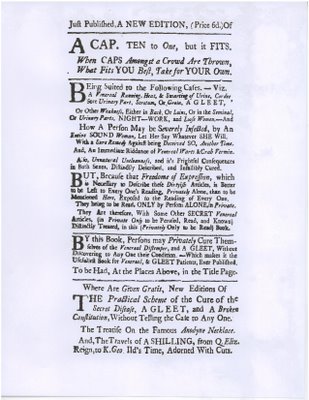
Salacious advertisements
From the printer's advertisements to A New Way of Breeding Canary Birds. Without the Trouble, that is in the Common Way of Breeding. And, Will Breed As Many Canary Birds Again, as the Common Way of Breeding does (London: J. Hughs, 1742):

Tim Adams on Bill Buford's maddening/charming ways
at The Observer:
The other reason that those of us in the office forgave him, though, was that when he put his mind to it Buford was the most inspired editor of other people's writing you had ever seen. You waited and waited for him to engage with something, but when he did it was, on occasion, like watching someone take apart an old Skoda, surround himself with all the greasy bits, and put it back together as, well, an XR3i. There was little you could not learn about sentences from him. Long, flat stories, 10,000 words of cliche, would return after a torrid night of Buford's attention without a single word in the place it had once been, and suddenly brimming with comedy and adventure. Some writers, particularly those who had not submitted long, flat stories in the first place, hated this dramatic intervention, of course, and great stand-offs would ensue. Others, realising that they had never ever sounded so good, would quibble a bit, and concede.
(Thanks to Maud for the link.)
The other reason that those of us in the office forgave him, though, was that when he put his mind to it Buford was the most inspired editor of other people's writing you had ever seen. You waited and waited for him to engage with something, but when he did it was, on occasion, like watching someone take apart an old Skoda, surround himself with all the greasy bits, and put it back together as, well, an XR3i. There was little you could not learn about sentences from him. Long, flat stories, 10,000 words of cliche, would return after a torrid night of Buford's attention without a single word in the place it had once been, and suddenly brimming with comedy and adventure. Some writers, particularly those who had not submitted long, flat stories in the first place, hated this dramatic intervention, of course, and great stand-offs would ensue. Others, realising that they had never ever sounded so good, would quibble a bit, and concede.
(Thanks to Maud for the link.)
Sunday, July 02, 2006
Dans ce val de larmes/Oslo-Seville
A mini-anthology of my favorite items in Harry Mathews' list-like The Orchard: A Remembrance of Georges Perec:
I remember Georges Perec expressing his appreciating of the toweling called Essuitout: "Ça essuie vraiment tout!"
I remember Georges Perec's bad teeth. They deteriorated unchecked during the years when he disliked himself. In 1975 he began going to a dentist (a woman, I think) to have them mended, a laborious procedure that he willingly endured.
I remember Georges Perec telling me that once on a radio broadcast he vaunted the largest Mont Blanc fountain pen at considerable length in the hope that the manufacturer would send him one.
I remember that before 1975 expressions such as dans ce bas monde and dans ce val de larmes figured frequently (if ironically) in Georges Perec's conversation; after that date, never.
I remember that Georges Perec had no esthetic prejudices.
I remember that Georges Perec wanted to establish the name un matiouze ("a Mathews") for the strong espresso I always ordered, using M's formula "a double espresso in a demitasse." In restaurants he would order un matiouze, then explain the term, hoping it would catch on--an impossible hope.
I remember that Georges Perec wore rounded shoes, often thick-soled, never tapered, never shinable, never ugly. They manifested his achieved desire to be firmly present in every situation.
I remember that during the summer I had a Eurail card, Georges Perec was disappointed that rather than simply using it to go where I needed, I didn't keep traveling back and forth between Oslo and Seville.
I remember Georges Perec expressing his appreciating of the toweling called Essuitout: "Ça essuie vraiment tout!"
I remember Georges Perec's bad teeth. They deteriorated unchecked during the years when he disliked himself. In 1975 he began going to a dentist (a woman, I think) to have them mended, a laborious procedure that he willingly endured.
I remember Georges Perec telling me that once on a radio broadcast he vaunted the largest Mont Blanc fountain pen at considerable length in the hope that the manufacturer would send him one.
I remember that before 1975 expressions such as dans ce bas monde and dans ce val de larmes figured frequently (if ironically) in Georges Perec's conversation; after that date, never.
I remember that Georges Perec had no esthetic prejudices.
I remember that Georges Perec wanted to establish the name un matiouze ("a Mathews") for the strong espresso I always ordered, using M's formula "a double espresso in a demitasse." In restaurants he would order un matiouze, then explain the term, hoping it would catch on--an impossible hope.
I remember that Georges Perec wore rounded shoes, often thick-soled, never tapered, never shinable, never ugly. They manifested his achieved desire to be firmly present in every situation.
I remember that during the summer I had a Eurail card, Georges Perec was disappointed that rather than simply using it to go where I needed, I didn't keep traveling back and forth between Oslo and Seville.
Déjà vécu
Evan Ratliff has a quite amazing article on memory disorders in the Times Magazine this week. Makes me want to write a novel....
Subscribe to:
Posts (Atom)