Showing posts with label Rome. Show all posts
Showing posts with label Rome. Show all posts
Friday, July 28, 2017


Wednesday, July 05, 2017
The artist moved to despair

Fuseli, "The artist moved to despair before the grandeur of ancient ruins" (1778-79) (via)
From Catherine Edwards, Writing Rome: Textual Approaches to the City: “The nature of the artist’s despair remains open. Is it provoked by the impossibility of emulating the greatness of the past, still overwhelming even in ruins? By the knowledge that even the greatest works of art will decay? Or is it rather caused by the unassuageable longing for a closer contact with the long vanished dead? These ruins, though of vast stature, are yet human in form; the artist stretches out his hand to touch flesh that turns out to be cold, unresponsive stone” (15).
Friday, November 18, 2016
Minor work update
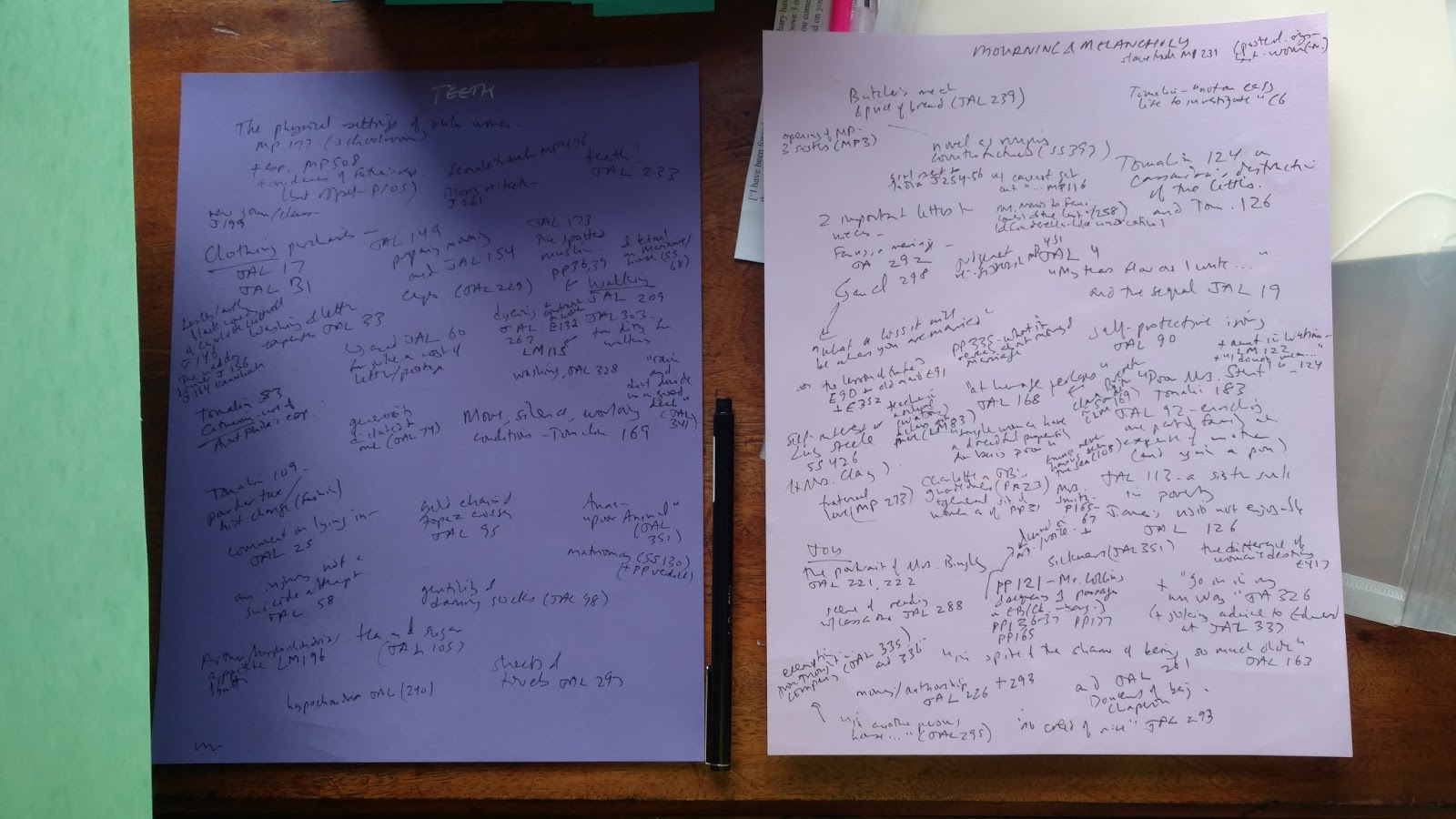
The Austen book has been a haven for me over the last couple of weeks. It's killing me to have to put it aside for a few days (weekend travel, then focusing on Gibbon and footnotes for the last two weeks I'm here and in preparation for my Balliol talk on self-annotation)! But I've just drafted chapter 6 of 8. Two more to draft, plus introduction and conclusion.
(It's currently draft zero, so it will need a couple weeks of cleaning up and filling in of references before it's a proper editable first draft - shooting to have proper full draft by Xmas. Due date to publisher in March, but I need to send it by late January so that I'm clear for six weeks of all-on Gibbon in Rome.)
Note to self: don't in future use such similar blues for two related chapters (revision, voice). Under artificial light, the sky-blue post-its are genuinely indistinguishable from the sea-blue ones!


(It's currently draft zero, so it will need a couple weeks of cleaning up and filling in of references before it's a proper editable first draft - shooting to have proper full draft by Xmas. Due date to publisher in March, but I need to send it by late January so that I'm clear for six weeks of all-on Gibbon in Rome.)
Note to self: don't in future use such similar blues for two related chapters (revision, voice). Under artificial light, the sky-blue post-its are genuinely indistinguishable from the sea-blue ones!

Saturday, November 05, 2016
Saturday night ruminations
Reading Decline and Fall XLI has given me an irresistible desire to reread one of my favorite Robert Graves novels, Count Belisarius. Amazingly it is available for Kindle! It is not of the caliber of I, Claudius (which I must have read a dozen times at least between the ages of 10 and 16), but I liked it very much when I was younger, and will be curious to see what I think now (that said, the commenters at Amazon are correct when they say that reading Procopius instead might be a valid choice!).
Very satisfying day - I am down the sabbatical rabbit-hole in the best possible way. Got up, did my 2hr run (a "running meditation" for a recovery week!), was so freezing in English flat afterwards that I went back to bed first just for huddling and then for napping, got up and just about produced quota on Austen, went to hot power yoga, came home, read Gibbon and now am going to retire, appropriately, to bed with a novel. Woo-hoo!
Very satisfying day - I am down the sabbatical rabbit-hole in the best possible way. Got up, did my 2hr run (a "running meditation" for a recovery week!), was so freezing in English flat afterwards that I went back to bed first just for huddling and then for napping, got up and just about produced quota on Austen, went to hot power yoga, came home, read Gibbon and now am going to retire, appropriately, to bed with a novel. Woo-hoo!
Monday, August 15, 2016
Conjectural histories
I have completely succumbed, by the way, to the allure of Gibbon. Excited about working on this project! Here are two small bits that may convey some of the quality I find so irresistible in Decline and Fall of the Roman Empire:
On Gordianus, father and son:
Or again, in a more contemplative vein (on the difficulty of writing about the empire c. 248-268 CE):
On Gordianus, father and son:
When he reluctantly accepted the purple, he was above fourscore years old; a last and valuable remains of the happy age of the Antonines, whose virtues he revived in his own conduct, and celebrated in an elegant poem of thirty books. With the venerable proconsul, his son, who had accompanied him into Africa as his lieutenant, was likewise declared emperor. His manners were less pure, but his character was equally amiable with that of his father. Twenty-two acknowledged concubines, and a library of sixty-two thousand volumes, attested the variety of his inclinations; and from the productions which he left behind him, it appears that the former as well as the latter were designed for use rather than for ostentation.(The note to that last sentence reads: "By each of his concubines, the younger Gordian left three or four children. His literary productions, though less numerous, were by no means contemptible.")
Or again, in a more contemplative vein (on the difficulty of writing about the empire c. 248-268 CE):
The confusion of the times, and the scarcity of authentic memorials, oppose equal difficulties to the historian, who attempts to preserve a clear and unbroken thread of narration. Surrounded with imperfect fragments, always concise, often obscure, and sometimes contradictory, he is reduced to collect, to compare, and to conjecture: and though he ought never to place his conjectures in the rank of facts, yet the knowledge of human nature, and of the sure operation of its fierce and unrestrained passions, might, on some occasions, supply the want of historical materials.
Ruin porn of the 18th century
Have just Amazoned a copy of James Crawford's book, reviewed a while ago by Mary Beard for the TLS (I had a copy via BorrowDirect briefly but it was recalled before I had a chance to read it - I think my borrowing privileges have been suspended three or four times this year for overdue recall books, and I've got another overdue BD book - Louise Curran's fascinating book about Samuel Richardson's correspondence that I forgot to return before I left NYC and that can't be renewed again, I read it but haven't transcribed my notes yet - that has probably just tipped me over again today into delinquency....). This is Beard's opening:
Inside the monastery of S. Trinità dei Monti, which stands at the top of the Spanish Steps in Rome, is a room decorated in glorious trompe l’oeil as a ruin. Created in 1766 by Charles-Louis Clérisseau, and originally intended to be the cell of the monastery’s resident mathematician Fr Thomas Le Sueur, it imitates a decaying classical temple, with tumbled columns, a roof open to the sky, encroaching vegetation and a large parrot perched on one of the apparently surviving crossbeams.
Wednesday, June 01, 2016
The transition to summer
Always awkward and more protracted than I would like! But this is the beginning of a full year of sabbatical - I won't be teaching again till September 2017 - and once I get into a groove, it should be pretty idyllic. I'll be based mostly in NYC with frequent trips to Cayman, but I have two really exciting additional places to be.
(And most immediately, I'll be embarking on the "Reading Austen" book and working on a few smaller non-academic bits, including a piece about Jenny Diski. Clarissa project has not been forgotten but is temporarily on the back burner....)
I'll spend the Michaelmas term (early October through early December) as an Oliver Smithies visiting lecturer at Balliol College, Oxford (I'll be working on the literary history of the footnote with special emphasis on Gibbon and history-writing).
And I'll spend six weeks in February and March as Sovern/Columbia Affiliated Fellow at the American Academy in Rome. Here is the project I'll be working on (I'm really excited about this!):
(And most immediately, I'll be embarking on the "Reading Austen" book and working on a few smaller non-academic bits, including a piece about Jenny Diski. Clarissa project has not been forgotten but is temporarily on the back burner....)
I'll spend the Michaelmas term (early October through early December) as an Oliver Smithies visiting lecturer at Balliol College, Oxford (I'll be working on the literary history of the footnote with special emphasis on Gibbon and history-writing).
And I'll spend six weeks in February and March as Sovern/Columbia Affiliated Fellow at the American Academy in Rome. Here is the project I'll be working on (I'm really excited about this!):
“Gibbon’s Rome”
“It was at Rome, on the fifteenth of October 1764,” wrote Edward Gibbon in a draft of his memoirs, “as I sat musing amidst the ruins of the Capitol, while the barefooted friars were singing vespers in the temple of Jupiter, that the idea of writing the decline and fall of the City first started to my mind.” Gibbon’s Decline and Fall of the Roman Empire would expand to treat the long history of the empire as it migrated east, not just the history of the city in which the empire had its origin, and his research took place in libraries, cabinets of medals and so forth in London, Paris, Lausanne and Geneva as well as in the streets of Rome. But the physical landscape of Rome as Gibbon first encountered it in the 1760s provided much of the emotional impetus for the project, and the city figures in the history in a number of different ways.
In “Gibbon’s Rome,” I am proposing a long essay or a short book (probably in the region of 40,000 words) that tells the story of what Gibbon saw in Rome and what it meant to him. I am envisioning a narrative not oriented exclusively towards scholarly readers but written more in the style of something like Mary Beard’s SPQR: A History of Ancient Rome; another model, in a rather different vein, is Geoff Dyer’s Out of Sheer Rage: Wrestling with D. H. Lawrence. The narrative will weave together a number of different strands with the goal of producing a lively narrative history with a literary-critical bent: recounting the series of choices and accidents that led Gibbon to Rome as a place and a topic; reading important passages from some of the works of history that were formative for Gibbon (this is a book about Gibbon’s reading as well as about Gibbon as tourist!) in earlier years and that contributed to the research techniques and evidentiary protocols that underpin Decline and Fall; considering the rise of the Grand Tour as a mode of self-cultivation and development for wealthy young British men over the first half of the eighteenth century; vividly describing the streets and buildings Gibbon walked through, the state they were in during this period and the kinds of collections of artifacts he was able to visit and examine; and of course analyzing and celebrating the language of Decline and Fall. I will draw on visual and journalistic records made by other visitors during the same period in order to bring the setting most powerfully to life.
My goal in this project is not just to recount the history of one historian’s relationship with one city, though that will occupy a good deal of my attention, but also to use the story of Gibbon’s encounter with Rome as a case study that gives us more general insight into how eighteenth-century writers came to understand the relationship between past and present and the tools for narrating and comprehending historical change. The context in which I developed this project involves a longstanding interest in the battle of ancients and moderns as it was worked out in Britain by combative writers like the textual editor Richard Bentley, Jonathan Swift and Alexander Pope, and my large-scale research project for the next few years will be to do the groundwork for an ambitious literary history of the footnote in the long eighteenth century. My interest in the footnote really derives from the fact that, as the scholar Evelyn Tribble has observed in an essay on the history of the transition from marginal annotation to footnotes, the shape of the page often becomes “more than usually visible” at periods when “paradigms for receiving the past are under stress”: “In the early modern period, as models of annotation move from marginal glosses to footnotes, the note becomes the battlefield upon which competing notions of the relationship of authority and tradition, past and present, are fought” (“‘Like a Looking-Glas in the Frame’: From the Marginal Note to the Footnote,” in The Margins of the Text, ed. D. C. Greetham [Ann Arbor: The University of Michigan Press, 1997], 229-244). Gibbon will feature in a chapter of that projected monograph, with the tension between the evidentiary impulse of the notes to the Decline and Fall and their fundamentally skeptical or ironic orientation towards the main narrative providing a starting point for a closer investigation of the footnote in British and French history-writing during this period. But I feel that there’s enough material, in the question of what Gibbon’s monumental history tells us about his own and his contemporaries’ understanding of the relationship between past and present as we comprehend it by way not just of books but by movement through ruins and landscapes and by interaction with historical artifacts, that I’ve made a commitment to pursue this smaller-scale project as a complement to the bigger one.
Six weeks at the American Academy in Rome would provide the ideal setting for some physical exploration of sites and museums alongside time in the library reading some of the narrative histories from which Gibbon took his inspiration as well as modern scholarship on the history of archeology and antiquities in Italy, museums and other viewing sites, other eighteenth- and nineteenth-century British visitors’ accounts of their relationship to the city, practices of historical restoration or reconstruction and so forth. An initial list of authors and books of particular interest to me would include Cicero, Livy’s histories, Erasmus’s Ciceronianus and the associated debate on Latin style, Bayle, Voltaire, Bossuet, le Sueur, de la Bléterie’s Life of Julian and Guischardt’s Mémoires critiques et historiques sur plusieurs points d'antiquités militaires. I would especially love to look closely through the collection of historical maps in the Rare Book Room; serendipity has a large role to play in this sort of project, and there will be no substitute for being physically on-site as I embark upon this research.

Friday, November 07, 2014
Friday, February 08, 2013
Thursday, March 18, 2010
Sample bias
At the TLS, Mary Beard considers two new books on the ancient Romans. Here, a description of Estelle Lazer's work on the bones of the dead of Pompeii:
Apart from some celebrity skeletons and plaster casts of dead bodies on display to the public, most of the human remains that survived the Allied bombing raids on the site during the Second World War were piled up in two main stores, each in an ancient bath building not normally accessible to ordinary visitors. Lazer spent most of her research time, months on end over seven years, in these depots – ill-lit (she worked for part of the time with a hand-held bicycle light) and infested by wildlife. The identifying labels once attached to the bones had long ago been eaten by rodents; many of the skulls had provided convenient nesting boxes for the local birds (covering the bones and what Lazer calls the key “skeletal landmarks” with bird lime); in one store a “cottage industry” had been established, which used the human thigh bones to make hinges to restore the ancient furniture on the site. “This has contributed”, as Lazer writes, with deadpan understatement, “a novel source of sample bias to the femur collection.”
Saturday, December 19, 2009
Obsessive Ciceronians
At the Sunday Times, a delightful review by Robert Harris of the paperback reissue of R. Shackleton Bailey's translation of Cicero's Philippics (I have been talking regularly about Ciceronian 'periods' in my style class this semester, and have had a bit of an urge to delve back into some orations - might be I should get a copy of this...):
Shackleton Bailey, known as “Shack”, who died in 2005 at the age of 87, was a Bletchley Park codebreaker who became the doyen of modern Cicero translators. He was also one of the great eccentrics of academia, famous for dedicating his edition of Cicero’s Letters to his cat (“Dono Donorum Aeluro Candidissimo”: “gift of gifts, whitest of cats”) and who allegedly resigned as a tutor from Jesus College, Cambridge when he was refused permission to cut a cat flap in his 16th-century oak door. (“His capacity for alcohol was vast,” noted his Times obituarist. “He used to stand on his head at social events.”)Here is the direct link to the Times obituary.
Subscribe to:
Posts (Atom)