Showing posts with label footnotes. Show all posts

Thursday, November 03, 2016

Work update

Oxford lifestyle continues idyllic - the weather and terrain are so perfect for running, and I have found great yoga and a great lifting coach to work out with. Went to London for a couple days over the weekend for some family visiting, and my mother was here for two nights which was very nice, but I am ready to plunge into total workaholism for the rest of the time I'm here - I must make a quick trip to Cambridge to see friends, but I don't think I'm going to go back to London, I just want to hole up and read and write!

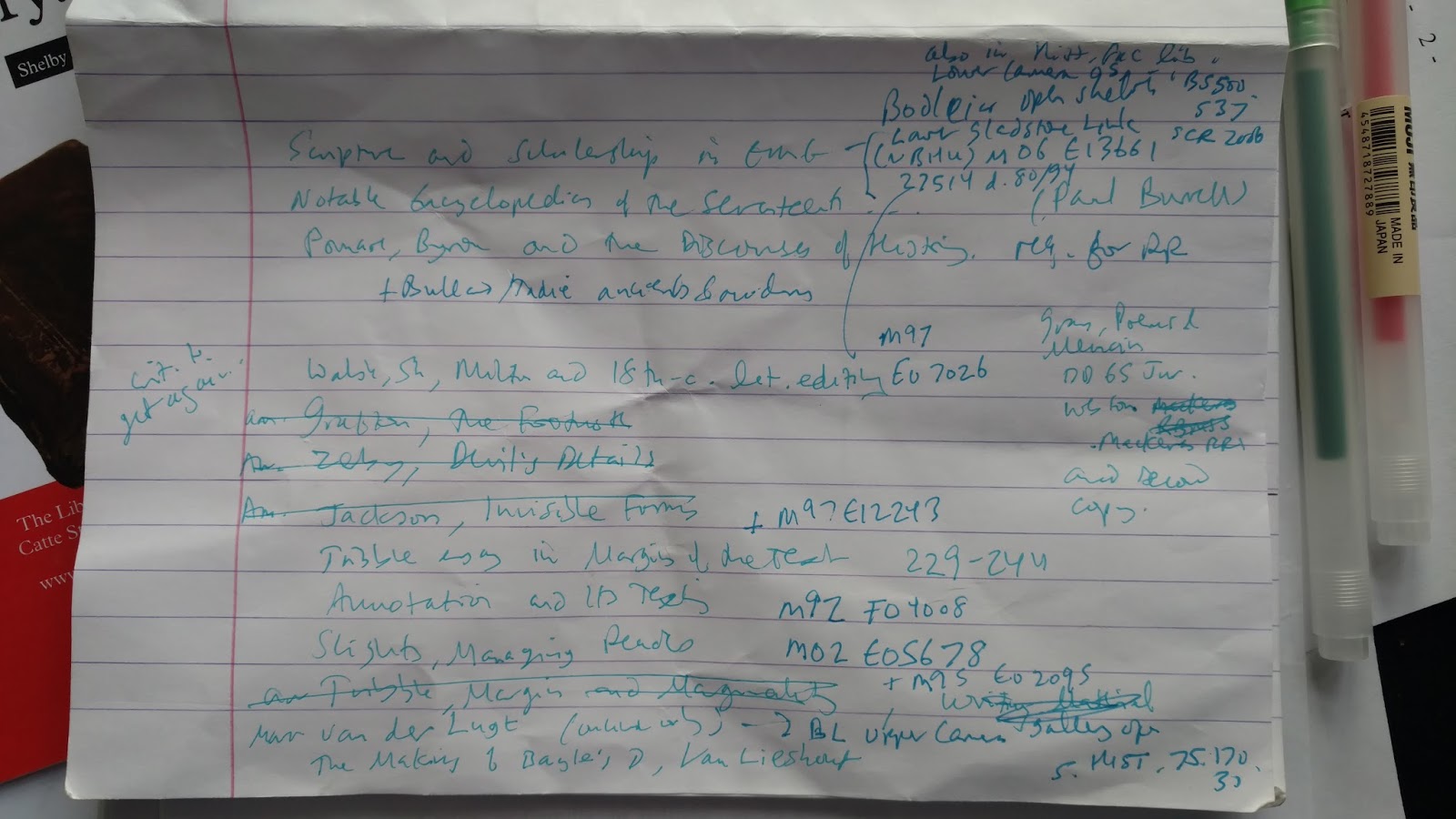
The only tricky thing for me work-wise just now is that I'm totally torn between my desire to draft the Austen book as expeditiously as possible (don't want to lose momentum) and my desire to (a) make use of library materials here to do broad reading for footnotology and (b) make progress on Gibbon project and make sure my lecture at the end of term on Gibbon and Gray is really good. I had an amazing evening of Gibbon-related reading last night that culminated in a massive plan and greater clarity: at home in NYC I have a great collection of Gibboniana from the library, but I don't need to reproduce that collection here, I will have access again in December; I do need to reimmerse myself in Gray (requested amazing slew of stuff to read at the Weston in the rare book room); and I do need to pull together at least a mini-footnote library to reimmerse myself and identify crucial primary sources for library investigation, couldn't bring that stuff with me as luggage book space was given over to the Austen volumes. So I've ordered four things from Amazon UK and identified the area of open stacks in the Bodleian where I can find the 10 or so other things I think I really need to have to hand (list can be found at the bottom of this post).

Austen, though! I hate to lose momentum! This is the chart I made once I had had a week of settling in. As I said previously, I don't think I can finish the draft while I'm here, but I should be able to have the book drafted in full (it is a very rough draft) by Xmas.

Going to step up the pace a bit now - I've drafted three chapters (out of eight, but it's possible that seven and eight aren't really two distinct chapters), so I'll press ahead with five days per chapter for the next three, on manners, morals and voice (one day of assembling the notes, four days of producing quota), then type up the notes for the remaining two chapters (teeth, mourning and melancholy) so that I've at least got something on paper.

I'll be doing some reading and library stuff in the meantime, but week 7 will be wholly devoted to footnotology and Bodleian-Weston time and week 8 will involve delivering my two talks, putting finishing touches on the second one (the first is ready to go) and spending some time with Brent, who will come over for that last week.

Bonus library method picture. (I do not know that there is better evidence for consistency of character than this - in fact, I wrote about it at least once before on this blog, it was a meme making the rounds in 2005 about what you'd look for in the library in 2015 and I will quote the relevant line here - "Then I would arm myself with a pen and paper (one thing I can guarantee is that in 2015 I will still be jotting down call numbers on the back of an old envelope or a supermarket receipt) and write down a huge long list of call numbers and hit the stacks and then go home for a huge orgy of reading.") (In this case it's on the other side of the piece of paper where I made notes about the new powerlifting warmup sequence!)
Saturday, October 15, 2016

Saturday evening snippet

End of week 1 (of 8) in Oxford. Really nice week! Though need to buckle down and start working properly - adjustment period is properly coming to a close....

A Saturday evening Gibbon snippet (new title for book is Gibbon's Rome: A Love Story - it is amazing how just sitting quietly and reading allows ideas to flow, I was having insane thoughts last night about how you would write an opera libretto that would bring the juxtaposition of the father-son dynamic, the father marrying and preventing the son from being able to do so - and not sending the money he promised so that Gibbon has to keep his brokeness a shameful secret from the friends he has been traveling with - and then the moment of impact when Gibbon actually meets Rome the city - but in my book, it's my own love story with the Decline and Fall as well):
I owe it to myself, and to historic truth, to declare, that some circumstances in this paragraph are founded only on conjecture and analogy. The stubbornness of our language has sometimes forced me to deviate from the conditional into the indicative mood.
Main task for remaining weeks is to draft as much of the Austen book as I can (I'm optimistic that I should be able to get most of it down on paper in at least a rough version, top limit of 50K I think for full book so 8 chapters at 5-6K each should be doable in a 1.5K production of quota fashion); glory in libraries and read massive amounts of general footnote stuff (mostly amazing primary sources, especially history and poetry, with footnotes); and (re)read a chapter a day of Gibbon to put myself in the mood.

One of my two talks for the end of term now has an explicit commitment to talk especially about Gray's and Gibbon's footnotes, so I will do some Gray reentry also in between the other footnote reading. Exploration of library system to begin Monday, must first have a proper writing session on Austen and must before that finish typing up notes for the first chapter so that I can proceed to the next stage!

Wednesday, June 01, 2016

The transition to summer

Always awkward and more protracted than I would like! But this is the beginning of a full year of sabbatical - I won't be teaching again till September 2017 - and once I get into a groove, it should be pretty idyllic. I'll be based mostly in NYC with frequent trips to Cayman, but I have two really exciting additional places to be.

(And most immediately, I'll be embarking on the "Reading Austen" book and working on a few smaller non-academic bits, including a piece about Jenny Diski. Clarissa project has not been forgotten but is temporarily on the back burner....)

I'll spend the Michaelmas term (early October through early December) as an Oliver Smithies visiting lecturer at Balliol College, Oxford (I'll be working on the literary history of the footnote with special emphasis on Gibbon and history-writing).

And I'll spend six weeks in February and March as Sovern/Columbia Affiliated Fellow at the American Academy in Rome. Here is the project I'll be working on (I'm really excited about this!):
“Gibbon’s Rome”

“It was at Rome, on the fifteenth of October 1764,” wrote Edward Gibbon in a draft of his memoirs, “as I sat musing amidst the ruins of the Capitol, while the barefooted friars were singing vespers in the temple of Jupiter, that the idea of writing the decline and fall of the City first started to my mind.” Gibbon’s Decline and Fall of the Roman Empire would expand to treat the long history of the empire as it migrated east, not just the history of the city in which the empire had its origin, and his research took place in libraries, cabinets of medals and so forth in London, Paris, Lausanne and Geneva as well as in the streets of Rome. But the physical landscape of Rome as Gibbon first encountered it in the 1760s provided much of the emotional impetus for the project, and the city figures in the history in a number of different ways.

In “Gibbon’s Rome,” I am proposing a long essay or a short book (probably in the region of 40,000 words) that tells the story of what Gibbon saw in Rome and what it meant to him. I am envisioning a narrative not oriented exclusively towards scholarly readers but written more in the style of something like Mary Beard’s SPQR: A History of Ancient Rome; another model, in a rather different vein, is Geoff Dyer’s Out of Sheer Rage: Wrestling with D. H. Lawrence. The narrative will weave together a number of different strands with the goal of producing a lively narrative history with a literary-critical bent: recounting the series of choices and accidents that led Gibbon to Rome as a place and a topic; reading important passages from some of the works of history that were formative for Gibbon (this is a book about Gibbon’s reading as well as about Gibbon as tourist!) in earlier years and that contributed to the research techniques and evidentiary protocols that underpin Decline and Fall; considering the rise of the Grand Tour as a mode of self-cultivation and development for wealthy young British men over the first half of the eighteenth century; vividly describing the streets and buildings Gibbon walked through, the state they were in during this period and the kinds of collections of artifacts he was able to visit and examine; and of course analyzing and celebrating the language of Decline and Fall. I will draw on visual and journalistic records made by other visitors during the same period in order to bring the setting most powerfully to life.

My goal in this project is not just to recount the history of one historian’s relationship with one city, though that will occupy a good deal of my attention, but also to use the story of Gibbon’s encounter with Rome as a case study that gives us more general insight into how eighteenth-century writers came to understand the relationship between past and present and the tools for narrating and comprehending historical change. The context in which I developed this project involves a longstanding interest in the battle of ancients and moderns as it was worked out in Britain by combative writers like the textual editor Richard Bentley, Jonathan Swift and Alexander Pope, and my large-scale research project for the next few years will be to do the groundwork for an ambitious literary history of the footnote in the long eighteenth century. My interest in the footnote really derives from the fact that, as the scholar Evelyn Tribble has observed in an essay on the history of the transition from marginal annotation to footnotes, the shape of the page often becomes “more than usually visible” at periods when “paradigms for receiving the past are under stress”: “In the early modern period, as models of annotation move from marginal glosses to footnotes, the note becomes the battlefield upon which competing notions of the relationship of authority and tradition, past and present, are fought” (“‘Like a Looking-Glas in the Frame’: From the Marginal Note to the Footnote,” in The Margins of the Text, ed. D. C. Greetham [Ann Arbor: The University of Michigan Press, 1997], 229-244). Gibbon will feature in a chapter of that projected monograph, with the tension between the evidentiary impulse of the notes to the Decline and Fall and their fundamentally skeptical or ironic orientation towards the main narrative providing a starting point for a closer investigation of the footnote in British and French history-writing during this period. But I feel that there’s enough material, in the question of what Gibbon’s monumental history tells us about his own and his contemporaries’ understanding of the relationship between past and present as we comprehend it by way not just of books but by movement through ruins and landscapes and by interaction with historical artifacts, that I’ve made a commitment to pursue this smaller-scale project as a complement to the bigger one.

Six weeks at the American Academy in Rome would provide the ideal setting for some physical exploration of sites and museums alongside time in the library reading some of the narrative histories from which Gibbon took his inspiration as well as modern scholarship on the history of archeology and antiquities in Italy, museums and other viewing sites, other eighteenth- and nineteenth-century British visitors’ accounts of their relationship to the city, practices of historical restoration or reconstruction and so forth. An initial list of authors and books of particular interest to me would include Cicero, Livy’s histories, Erasmus’s Ciceronianus and the associated debate on Latin style, Bayle, Voltaire, Bossuet, le Sueur, de la Bléterie’s Life of Julian and Guischardt’s Mémoires critiques et historiques sur plusieurs points d'antiquités militaires. I would especially love to look closely through the collection of historical maps in the Rare Book Room; serendipity has a large role to play in this sort of project, and there will be no substitute for being physically on-site as I embark upon this research.

Tuesday, December 29, 2015

Footnotology

Have sacrificed my morning run in order to get a handle on the huge list of tasks that need to be done in advance of tomorrow's travels. First up: returning a long-overdue ILL book I procured at great trouble earlier this year.

Peter Riess's Footnotology: Towards a Theory of the Footnote (New York and Berlin: Walter de Gruyter Publishers, 1985): “The footnote is (or pretends to be) the carrier of academic information, but is not the object of academic study” (3).

A functional typology of footnotes (pp. 15-17): excursive, supplementary, cautionary, disassociative, disputatious, cartel, clique, camouflage. Footnote neurosis, footnote fetishism, footnoteophobia, footnote aversion.

I am laughing, I think I now have something like five prospective book projects that are equally important to me (reading Austen, reading Clarissa, Gibbon's Rome, triathlon memoir, etc. etc.), but the biggie longterm one right now (I've just sent out a proposal for a short-term research fellowship) is for the most ambitious academic book I have contemplated to date, a literary history of the footnote, 1680-1818. Here is some of what I wrote recently:
In an essay on the history of the transition from marginal annotation to footnotes, Evelyn B. Tribble has suggested that the shape of the page often becomes “more than usually visible” at periods when “paradigms for receiving the past are under stress”: “In the early modern period, as models of annotation move from marginal glosses to footnotes, the note becomes the battlefield upon which competing notions of the relationship of authority and tradition, past and present, are fought” (“‘Like a Looking-Glas in the Frame’: From the Marginal Note to the Footnote,” in The Margins of the Text, ed. D. C. Greetham [Ann Arbor: The University of Michigan Press, 1997], 229-244). In this context, the page itself rather than the book in all of its rich materiality becomes the focus of interest. This matters for a number of significant literary works of the period that are still widely read, and the monograph that I am looking towards writing will be structured around discussion of those more or less canonical texts: Swift’s Tale of a Tub, Pope’s Dunciad, Richardson’s Clarissa and its increasingly controlling use of footnotes to cross-reference and moralize in subsequent revisions, the self-annotation of mid-century poets such as Thomas Gray and James Grainger, the apotheosis of the footnote in Gibbon’s Decline and Fall of the Roman Empire, with a convenient end point provided by the multiple texts of Coleridge’s Rime of the Ancient Mariner and the notorious marginal glosses of the version published in 1817. But I want to offer very full contextualization concerning the more general literary and historical record; more than that, I suspect that there is a good deal of interpretive work to be done on books with footnotes in their own right, especially in the genre of history.

The practices of glossing and marginalia run much longer than the history of the printed book, but I am especially interested in the new structures of page-based meaning that are facilitated by the sudden predominance of notes at the foot of the page rather than as a long appendage at the end of the text as the annotating authors of printed books in the 1680s move relatively quickly from margins to the foot of the page (Marcus Walsh has identified the French historian Richard Simon as an important node of change here, and his books are one of my first targets, with another important early French exemplar being Brossette’s two-volume 1716 edition of Boileau, whose importance for Pope’s vision of what could be done in the Dunciad Variorum has been roundly demonstrated by James McLaverty). These footnotes are continuous with older forms but also strikingly innovative in various respects, not least because one promise of the print world is that an author can relatively easily sanction multiple editions of his or her own work with increasingly complex and multi-layered annotation. One of my interests here is authorial involvement in the production of multiple editions of a given work, not revision in the most general sense but the specific problem of revision as it comes up in the question of writers with a compulsion to annotate their own works. I will be especially keen to find multi-edition works whose critical apparatus increases with each iteration or indeed in some cases transforms the work at hand.

Some initial theoretical work on this concept was done in Gérard Genette’s Paratexts, and the monograph I will ultimately write will touch briefly on some important twentieth-century forms of authorial annotation (The Waste Land, Pale Fire, the novels and essays of David Foster Wallace). In the early modern period, much of the footwork on this topic has been done and has begun to be elaborated in sophisticated critical works: Evelyn Tribble, Anthony Grafton, William Slights in his work on marginalia. But though work has begun in this area in the long eighteenth century, I was taken aback to realize when I began delving into the critical literature that there was no existing literary history of the footnote in this period; I think there’s a need for it, and I think what I must do before anything else is read exhaustively across the 12 or so decades I am contemplating (but with an initial concentration in the first half of the period) just to track the use of the footnote across major genres in English and French. I am especially interested in history, poetry and the novel, but I will be keeping an eye out for other genres that may prove especially interesting (natural history, say, or theology and moral philosophy – I will initially cast a very wide net).