Showing posts with label planning. Show all posts

Friday, November 18, 2016

Minor work update

The Austen book has been a haven for me over the last couple of weeks. It's killing me to have to put it aside for a few days (weekend travel, then focusing on Gibbon and footnotes for the last two weeks I'm here and in preparation for my Balliol talk on self-annotation)! But I've just drafted chapter 6 of 8. Two more to draft, plus introduction and conclusion.

(It's currently draft zero, so it will need a couple weeks of cleaning up and filling in of references before it's a proper editable first draft - shooting to have proper full draft by Xmas. Due date to publisher in March, but I need to send it by late January so that I'm clear for six weeks of all-on Gibbon in Rome.)

Note to self: don't in future use such similar blues for two related chapters (revision, voice). Under artificial light, the sky-blue post-its are genuinely indistinguishable from the sea-blue ones!

Saturday, September 10, 2016

The dining-room table

I am long overdue a light reading update - I have a resolution to do that at least once a month going forward, otherwise the titles mount up so alarmingly that the task begins to seem overly Herculean - but this is really what I have been working on this month.  Working intensively on a new book project always feels like coming home; smaller or shorter things don't have that feeling of entering a real intellectual world, and my only regret is that I can't have one hemisphere of the brain working on Austen while the other works on Gibbon, which is also at the alluring early stage where everything seems possible and there are almost infinite amounts of appealing new material yet to be unearthed and assembled into some kind of a sensible narrative.

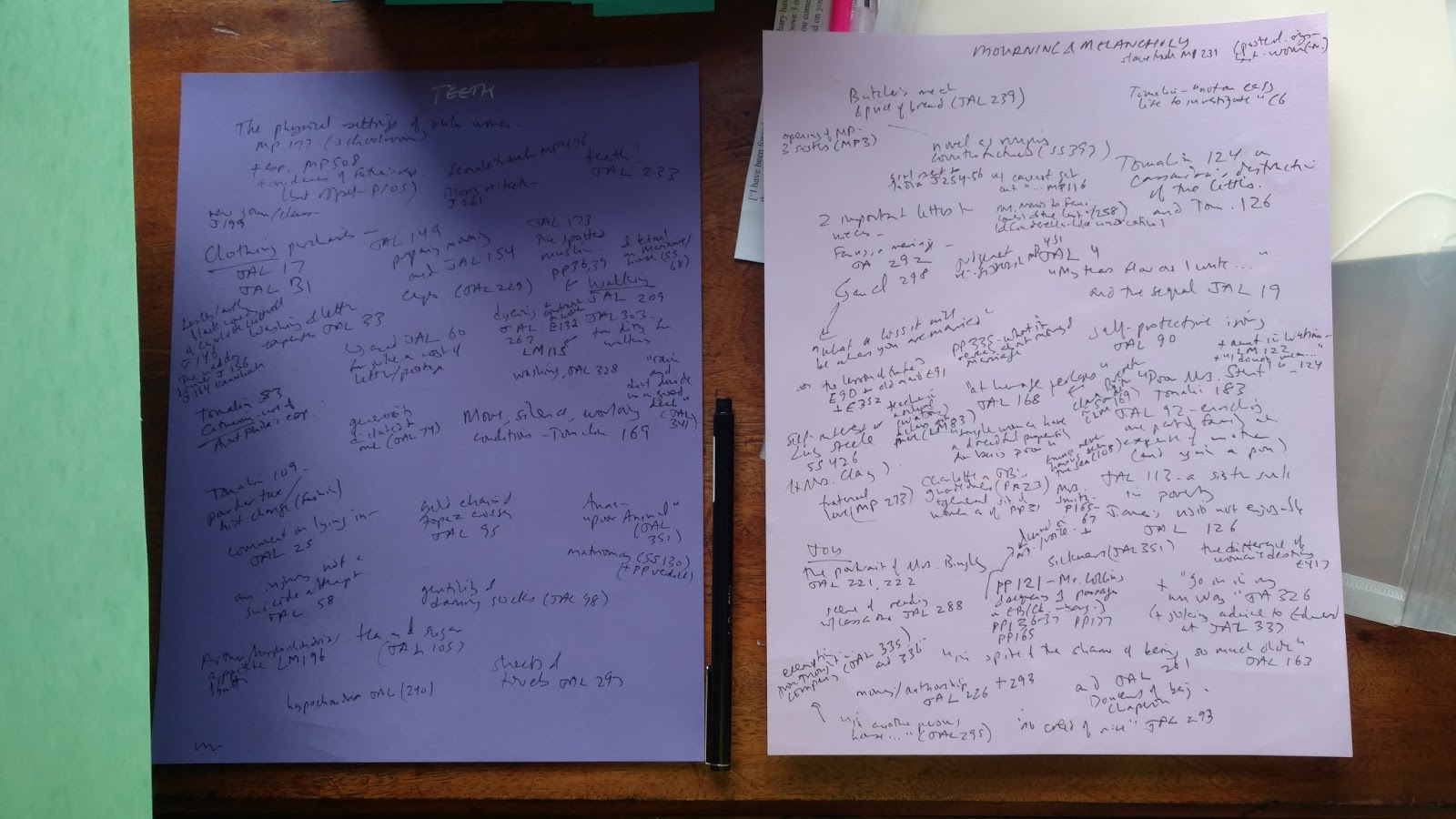
Each project asks for its own method - and its own combination of stationery and writing implements! - but this one is more colorful than the last few I've done.  I've already modified the plan from my proposal, and I currently intend to write the book - Reading Jane Austen, an installment in a new Cambridge series that began with Reading William Blake and continued with Reading John Keats - in eight chapters, coded by color here.  First I reread through the complete works plus biography and letters, marking up with a pen.  Then I set up the provisional topics for individual chapters - Letters, Conversation, Revision, Manners, Morals, Voice, Teeth (someone is going to make me change that title later I suspect! But basically, all the gruesome details of social history and ailments of the body that lurk around the edges in Austen's writing), Mourning and Melancholy.  Each one has its own page and a color-coded set of post-its, so that when I then went back through my marked-up volumes, I stuck a post-it to categorize points in the books and also transferred a cryptic notation under the appropriate heading, loosely organized on the page though certainly not rigorously so.

The next step will be to type up these notes in individual files, then to start working on the chapters - I like "pushing" a project in its entirety through from stage to stage, so I'll probably get all the notes typed up and only then start writing rather than taking chapters one at a time.  I had this in retrospect quite unrealistic fantasy that I could type up ALL THOSE NOTES (the book is only supposed to be about 60,000 words, not a long one) before I fly to Australia on Sept. 19, but that does not seem likely to happen - it would take more time and concentration than I probably have available to me in this coming week, which also features quite a few evening work engagements, to manage notes on a chapter-per-day basis.  That said, it is worth trying - or else B. will be wondering why I have brought a very heavy bookpack of work stuff on vacation with me, as once I get going on a job like this I really hate to put it aside before it's done!  (More sensibly, if I have "Letters" notes typed up I could work on drafting that chapter from notes, that wouldn't require bringing such a heavy load with me.)


Tuesday, December 15, 2015

Closing tabs

Trying to tidy up my utterly chaotic apartment - but the counterpart bit of tidying involves closing a lot of tabs that have been open for too long....

Best sight over Thanksgiving - PEZ dispensers at the American Visionary Art Museum in Baltimore!

Closing some tabs:

Photographs of Arctic foxes.

William McIlvanney has died - his Laidlaw books were a favorite with my Scottish grandfather.

Novel-reading has been fairly pitiful, though I need to write separate posts on books by Elana Ferrante and Garth Greenwell that are not pitiful.

Hahahahaha, have been contemplating this line as I thought longingly about blogging - am now on installments 13 to 15 of Sherrilyn Kenyon's Dark-Hunter novels - they are very good storytelling in their way, albeit somewhat repetitive when binge-read; I would like them better if there were less sex, but this is like saying I would like chocolate chip cookies better if there were no chocolate chips in them! (Also true.) Resolved to read a higher proportion of nonfiction in 2016 as there is less brain rot that way!

Actually I have had quite a few good things now that I think about it - I am always in peaks and troughs of despair and elation, fortunately something good usually turns up to read just when I am utterly dry....

Appealing caper crime: Lou Berney's first two novels, which are not so much my cup of tea as his most recent one but which are still incredibly good - I think he's my new favorite relative-newcomer crime writer.

Another very good first crime novel (from a veteran writer, and it shows): Lisa Sandlin, The Do-Right. There is perhaps a tad too much historical detail, but the writing is excellent and the storytelling is very good too (not always the case): Attica Locke is the closest parallel. I highly recommend this one - I think it will appeal slightly less to the general reader than Berney's The Long and Faraway Gone, as the historical setting is a little too lovingly realized and the story is less plausible, but it is worth mentioning in the same breath, especially on the strength of the characters and the prose.

Denisa Mina's excellent new Alex Morrow novel, Blood, Salt, Water.

Kevin Wignall, A Death in Sweden - great stuff! Not perhaps quite up to Peter Temple in the writing, but very good indeed - that is a standard few can meet, and this is definitely first-rate. Wignall's first few books made a big (positive) impression on me, but he hasn't been on my radar in recent years, and I am hoping that may mean there's some backlist I can catch up on. I just like this guy's brain - you know when you read a novel and it is so intelligent and compact and contained that you feel like you could live with it in your house?

Comfort reread when I couldn't find anything else: Eva Ibbotson, A Song for Summer (I love her books so much and it makes me very sad that there will be no more of them).

Appealing SF: C. A. Higgins, Lightless (I loved this one, and was perplexed by the negative Amazon reviews - yes, this is a little more simplistic than the Expanse books, say, in the best tradition of YA SF of the 50s and 60s, but it is incredibly gripping and the characters are really nicely brought to life - I hugely enjoyed it).

Mira Grant's latest sapient tapeworm installment, Chimera (she is a genius of light reading, everything she writes is what I most enjoy reading). Good thing for me she is so prolific! (And by the way, when did it become acceptable to apply the adjective "prolific" to, say, serial killers? I see it often and it always strikes me as a solecism!)

On the topic of serial killers, a rather terrible book by Alan Jacobson ccalled The 7th Victim. It is capably written and presumably reasonably well-informed about profiling and FBI procedures, but the main character is so utterly preposterous in her motivations and actions that it ruined everything else good about the book for me. (It reminded me of this very good recent post by Charlie Stross - writers take note....)

Three enjoyable and very light books by Deborah Blake, who I will continue to read despite what I feel to be the basic silliness of this kind of paranormal romance because she is a good writer!

My Greenwell and Ferrante posts may have to wait for another day, that's enough blogging after a long dry spell!

Final thought. If I can do four things tomorrow, everything will be OK:

(1) Run
(2) Finalize my spring-semester syllabus, which will involve a bit of library time, and email it to seminar leaders for Thursday morning meeting
(3) Write the two most pressing letters of recommendation
(4) Get to 5pm makeup powerlifting session

Saturday, September 06, 2014

Weekend chaos!

In minor chaos and disarray at this end! I am having a very good month: my only complaint about it is that all the good things are happening in a very compressed time period, whereas I know there will be long dull stretches at other points that would have benefited from this kind of stimulus!

(New Tana French was so good that I just wanted to read it all over again when I finished. Also enjoying Vikram Chandra's new book - excerpt here - but fuller light reading log will have to await some more leisurely moment. Had a great meeting Thursday with an editor I'm keen to write for, found a very good dress yesterday to wear for my one annual professional black-tie event, new semester still has the glow on it, etc. etc.)

Heading off in a couple hours to New Paltz for the SOS Triathlon. My brother and his family are crewing for me - niece GG just had her first day of kindergarten on Thursday, as well as her fifth birthday on Tuesday, so I am excited to hear all about it on the car on the way there! I'm taking NJ Transit out to where they are - they have just moved into a new house in Rutherford, this will be my first visit (of many I hope!).

Haven't finished everything for Monday's initial seminar meeting, but the syllabus is finalized and I don't teach till late afternoon, so that should be OK - ditto Tuesday's class on Milton. One letter of recommendation that I will try and squeeze out this morning if I can get tidied up and packed in sufficiently good time. One more tenure letter due the 15th, but it was slightly amazing that I got two of the other ones done over the holiday weekend.

Triathlon: sport of stuff!

Syllabus design also breeds an accumulation of things:

And then there's the OTHER syllabus!

Tuesday, April 29, 2014

Blindness, insight

At the LARB, a very good essay by Jonathan Freedman on the topic of Paul De Man:
De Man was a mediocre student (largely because he took engineering and chemistry courses), but he was steeped in different traditions than his US peers: existentialism, modernism, the avant-garde both before and after the second World War — indeed in America, he served as an important conduit to European thought, writing on Walter Benjamin before it was de rigueur, engaging in dialogue with Derrida when Derrida was largely unknown, turning in his later works to an encounter with Adorno. And there remain important continuities between de Man and his European elders. It’s important to remember, for example, that one of de Man’s major late essays is called The Return to Philology, by which he meant a return to a rigorous attention to the linguistic specifics of a text in and of itself without recourse to any humanistic pap or moral, ethical, or hermeneutical hijinks. Whether this is an adequate “return,” I leave to the philologists to debate; what seems important is that late in his life, de Man affiliated himself with a tradition of European thought that began, as Jeffrey Harpham has reminded us, in the 18th century’s demystification of Biblical texts and thence to Nietzsche’s madcap philologism before it rolled across the seas in the 20th century. More generally, explication de texte as a method was rooted, in its Comparative Literature aspects, in philology, and competed with — even as it ultimately merged into — the superior pedagogically (because more accessible) but inferior intellectually (because un-self-critical) Anglo-American “New Criticism,” with its emphasis on close reading as a method. Deconstruction in its de Manian guise needs to be understood under the sign of this genealogy, as an attempt to bring the demystifying essence of the philological perspective and close attention to literary detail inherent in the explication tradition together as a critical method.
Had a meeting today about the course I am teaching in the fall: it is called "Literary Texts, Critical Methods," and it is the required introduction to critical approaches that all our undergraduate majors take, preferably in their second year. An interesting challenge, but also a daunting one!