I had a very good concentrated spell of work this morning, the task being to revise the syllabus for my Epic Histories class and get the new information out to students. (I've promised them a digital "packet" as well - a single PDF with all the pages for option 1 - on the grounds that sometimes when things are overwhelming it's easier to just read one thing that you could even open on your phone as opposed to wrangling different books and digital files. Planning to use CamScanner - upgraded today to Pro and am hoping that I will be able combine individual page images into a single file within the app.)
Here's the new version of the rest of the semester. I've cut a few things altogether (Nadar's memoir! Benjamin on photography!) and given a bare-minimum option for those whose concentration is failing them. In going through my old class notes and the pages of the Arcades Project, I kind of fell in love with it all over again....
p.s. I think I got the idea of three different levels from the way you show poses as a progression in a yoga class!
Revised syllabus (spring 2020)
3/30 Option 1:
Decline and Fall 1:446, 1:471-74, 1:518-21, 1:524, 1:576-81
Pocock, “Gibbon and the primitive church,” 50-53, 66-68
Pocock, “Putney, Oxford and the question of English Enlightenment,” 44-46
Option 2:
Option 1 + all of chapter XVI
Option 3: original reading
Decline and Fall chapters XIV-XVI (vol. 1)
*J.G.A. Pocock, “Gibbon and the primitive church,” in History, Religion, and Culture: British Intellectual History 1750-1950, ed. Stefan Collini, Richard Whatmore and Brian Young (Cambridge: Cambridge University Press, 2000), 48-68
*Pocock, “Putney, Oxford and the question of English Enlightenment,” in Barbarism and Religion, vol. 1: The Enlightenments of Edward Gibbon, 1737-1764 (Cambridge: Cambridge University Press, 1999), 13-49
*David Womersley, “Gibbon and the ‘Watchmen of the Holy City’: Revision and Religion in the Decline and Fall,” from Edward Gibbon and Empire, ed. Rosamond McKitterick and Roland Quinault (Cambridge and New York: Cambridge University Press, 1997),190-216
*B. W. Young, “Gibbon, Newman, and the Religious Accuracy of the Historian,” from The Victorian Eighteenth Century: An Intellectual History (Oxford and New York: Oxford University Press, 2007), 70-102
4/6 Arcades: an introduction
Option 1:
Benjamin, “Paris, the Capital of the Nineteenth Century,” 13
Convolute C: epigraph through C6 (82-83), C4 (90-91), C6a,2 + C7,1 (95), 9a,2 (100)
Sieburth, “Benjamin the Scrivener,” 7-11
Johnson, “Passage Work,” 82-84
Option 2:
Option 1 + all of “Paris, the Capital…” and Sieburth
Option 3: original reading
Benjamin, “Paris, the Capital of the Nineteenth Century” (1935) (AP 2-13)
Convolutes A, C and P: “Arcades, Magasins de Nouveautés, Sales Clerks” (AP 31-61), “Ancient Paris, Catacombs, Demolitions, Decline of Paris” (AP 82-100), “The Streets of Paris” (AP 516-526)
*Richard Sieburth, “Benjamin the Scrivener,” Assemblage 6 (1988): 6-23
*Barbara Johnson, “Passage Work,” in Walter Benjamin and The Arcades Project, ed. Beatrice Hanssen (London and New York: Continuum, 2006), 66-86
*“Encounters,” from Peter Buse, Ken Hirschkop, Scott McCracken and Bertrand Taithe, Benjamin’s Arcades: An unGuided tour (Manchester and New York: Manchester University Press, 2005), 1-12
4/13 Baudelaire I
Option 1:
Convolute J: J1,5 (230), J3,2 (233), J3a,1 (234), J41,3 (302), J44,3 (308), J51a,5 (321), J55a,5 (329), facing pages 332-33
Baudelaire, “The Sun”/Le Soleil,” “The Swan”/“Le Cygne”
Option 2:
Option 1 + further reading in Convolute J
Option 3: original reading
Convolute J: “Baudelaire” (228-386)
Baudelaire, “The Painter of Modern Life”
*T. J. Clark, “Should Benjamin Have Read Marx?,” boundary 2 30:1 (2003): 31-49
*Max Pensky, “Tactics of Remembrance: Proust, Surrealism, and the Origin of the Passagenwerk,” in Walter Benjamin and the Demands of History, 164-189
4/20 Baudelaire II
Option 1:
The four spleen poems
Benjamin, “On Some Motifs in Baudelaire,” 182-85
Edgar Allan Poe, “The Man of the Crowd”
Option 2:
Option 1 + Haroutunian 62-67 (not on original syllabus)
Option 3: original reading
*Benjamin, “On Some Motifs in Baudelaire,” from Illuminations (155-200)
Selections from The Flowers of Evil: “To the Reader”/“Au lecteur,” “Correspondences”/“Correspondances,” “A Former Life”/“La vie antérieure,” “The Ideal”/“L’Idéal,” “‘I love you as I love . . .’”/ “‘Je t’adore à l’égal,” “Spleen” 1-IV, “The Taste for Nothingness”/“Le Goût du néant,” “The Sun”/“Le Soleil,” “The Swan”/“Le Cygne,” “To a Woman Passing By”/“A une passante,” “Gaming”/“Le Jeu,” “Meditation”/“Recueillement”
4/27 Baudelaire III
Option 1:
Convolute M: M3a,4 (423), M5,6 (427), M13a,2 (442), M16,3 (446), facing pages 447-48
Convolute m: m2,1 (801-2)
Buck-Morss, “The Flâneur,” 33-43
Option 2:
Add full Buck-Morss
Option 3: original reading
Convolutes M, m: “The Flâneur” (AP 416-455), “Idleness” (AP 800-806)
*Susan Buck-Morss, “The Flâneur, the Sandwichman and the Whore: The Politics of Loitering,” in Walter Benjamin and The Arcades Project, 33-65
*Françoise Meltzer, “Money (La chambre double)” (selections), from Seeing Double: Baudelaire’s Modernity (Chicago and London: University of Chicago Press, 2011), 138-180
5/4 Knowledge, Progress, History
Option 1:
“Theses on the Philosophy of History”: IX (257), XIV (261), XVII (263)
Convolute N: N1,3 (456), N1,10 (458), N1a,8 + N2,1 (460), N3,4 (463), N4,2 + 4,3 (464), N7a,7 (470), N9,6 + N9,8 (473), N9a,6 (474), N10,3 (476), N15,2 (481), N19,2 (487)
Rolleston, “The Politics of Quotation,” 13-17
Arnaldo Momigliano, “Historicism Revisited,” in Essays in Ancient and Modern Historiography (Chicago: University of Chicago Press, 2012), 365-73
Option 2:
Option 1 + all of Convolute N and the “Theses”
Option 3: original reading
Convolute N: “On the Theory of Knowledge, Theory of Progress” (AP 456-488)
*Benjamin, “Theses on the Philosophy of History,” Illuminations (253-64)
*Letter from W. Benjamin to G. Adorno
*James L. Rolleston, “The Politics of Quotation: Walter Benjamin’s Arcades Project,” PMLA 104:1 (Jan. 1989): 13-27
*Stathis Gourgouris, “The Dream-Reality of the Ruin,” in Walter Benjamin and The Arcades Project, 201-24
*“The Angel of History,” from Benjamin’s Arcades: An unGuided tour, 95-104
*Arnaldo Momigliano, “Historicism Revisited,” in Essays in Ancient and Modern Historiography (Chicago: University of Chicago Press, 2012), 365-73
Showing posts with label Edward Gibbon. Show all posts
Thursday, March 26, 2020
Friday, March 29, 2019
On procrastination in letter-writing
It was a funny convergence....
I've been writing this week under the auspices of a fourteen-day boot camp organized by the National Center for Faculty Development and Diversity; my college classmate and fellow academic Julie Lynch was praising this organization on Facebook a few weeks ago, so when I got an email from the provost's office shortly thereafter saying that Columbia is now a member and that we would have free use of many of its resources, I thought I should give it a try. In fact since I am on sabbatical (and since I have long hewed to a "production of quota" method that basically is very similar to what these boot camps do) it was not really necessary, but if I am going to recommend it to others, I will always prefer to have tried it myself.
Anyway, today's writing was fun because I got to the part of my skeleton draft that includes all the material about Gibbon's habit of putting off writing important letters! He refers in a letter to his good friend Holroyd to "[t]he aversion to Epistolary Conversation, which it has pleased the Daemon to implant in my nature” (2:14), and the problem produces many very funny but also rather painful expressions of penitence and shame.
This is from a letter to Gibbon's Swiss friend Deyverdun, apologizing for a long silence: “my long silence has been occasioned, as far as I understand the anatomy of my own mind, by various reasons: during the summer it was mere idleness and procrastination: from the meeting of Parliament, when it became necessary to finish my book and to subdue America I found myself really involved in a greater hurry of public private and litterary business than I have ever known in any part of my life” (2:104).
There are a lot of good ones to Holroyd:
I've been writing this week under the auspices of a fourteen-day boot camp organized by the National Center for Faculty Development and Diversity; my college classmate and fellow academic Julie Lynch was praising this organization on Facebook a few weeks ago, so when I got an email from the provost's office shortly thereafter saying that Columbia is now a member and that we would have free use of many of its resources, I thought I should give it a try. In fact since I am on sabbatical (and since I have long hewed to a "production of quota" method that basically is very similar to what these boot camps do) it was not really necessary, but if I am going to recommend it to others, I will always prefer to have tried it myself.
Anyway, today's writing was fun because I got to the part of my skeleton draft that includes all the material about Gibbon's habit of putting off writing important letters! He refers in a letter to his good friend Holroyd to "[t]he aversion to Epistolary Conversation, which it has pleased the Daemon to implant in my nature” (2:14), and the problem produces many very funny but also rather painful expressions of penitence and shame.
This is from a letter to Gibbon's Swiss friend Deyverdun, apologizing for a long silence: “my long silence has been occasioned, as far as I understand the anatomy of my own mind, by various reasons: during the summer it was mere idleness and procrastination: from the meeting of Parliament, when it became necessary to finish my book and to subdue America I found myself really involved in a greater hurry of public private and litterary business than I have ever known in any part of my life” (2:104).
There are a lot of good ones to Holroyd:
You wish I would write as a sign of life. I am alive, but as I am immersed in the decline and fall, I shall only make the sign.—It is made. (2:246-47)And to his stepmother: “… you will be satisfied to hear that for many Wednesdays and Saturdays, I have consumed more time than would have sufficed for the Epistle in devising reasons for procrastinating it to the next post” (3:130).
Since my retreat to Lausanne our Correspondence has never received so long an interruption, and as I have been equally taciturn with the rest of the English World it may now be a problem among that sceptical nation whether the historian of the decline and fall be a living substance or an empty name. So tremendous is the sleepy power of laziness and habit, that the silence of each post operated still more strongly to benumb the hand and to freeze the Epistolary ink. (3:4)
Sunday, October 21, 2018
Wormwood forest
Ah, I see that it is exactly a year since I last posted here - a link to Gene's obituary. He has been much on my mind this month, for obvious reasons.
Am deep in Gibbon book and its writing - just spent the afternoon reading a book that I first heard about more than ten years ago (in this TLS review, though I can't access the whole piece without requesting it through ILL - in all these years, the TLS still hasn't improved the usability of its archive!), Mary Mysio's Wormwood Forest: A Natural History of Chernobyl. It is a very good book without being a great one (the excellence of the topic exceeds the skill level of the writer, perhaps - the copy-editing isn't great and in the hands of a different publisher it might have developed into something more for the ages). Which is to say that it doesn't have the literary force (the unforgettable shock value) of Svetlana Alexievich's Voices From Chernobyl: An Oral History of a Nuclear Disaster, with which it must be read in tandem (I'm thinking about a reread now). And yet it is an absolutely extraordinary story! Not least in the episode it recounts about the release into the wild of several small herds of Przewalski's horses, a longtime favorite of mine (I just saw some at the small zoo at the Jardin des Plantes the other week).
My reading was prompted by this passage in Gibbon, in which he discusses the repeated and ongoing invasions of the Illyrian provinces after the death of Valens:
Am deep in Gibbon book and its writing - just spent the afternoon reading a book that I first heard about more than ten years ago (in this TLS review, though I can't access the whole piece without requesting it through ILL - in all these years, the TLS still hasn't improved the usability of its archive!), Mary Mysio's Wormwood Forest: A Natural History of Chernobyl. It is a very good book without being a great one (the excellence of the topic exceeds the skill level of the writer, perhaps - the copy-editing isn't great and in the hands of a different publisher it might have developed into something more for the ages). Which is to say that it doesn't have the literary force (the unforgettable shock value) of Svetlana Alexievich's Voices From Chernobyl: An Oral History of a Nuclear Disaster, with which it must be read in tandem (I'm thinking about a reread now). And yet it is an absolutely extraordinary story! Not least in the episode it recounts about the release into the wild of several small herds of Przewalski's horses, a longtime favorite of mine (I just saw some at the small zoo at the Jardin des Plantes the other week).
My reading was prompted by this passage in Gibbon, in which he discusses the repeated and ongoing invasions of the Illyrian provinces after the death of Valens:
Could it even be supposed, that a large tract of country had been left without cultivation, and without inhabitants, the consequences might not have been so fatal to the inferior productions of animated nature. The useful and feeble animals, which are nourished by the hand of man, might suffer and perish, if they were deprived of his protection: but the beasts of the forest, his enemies, or his victims, would multiply in the free and undisturbed possession of their solitary domain. The various tribes that people the air, or the waters, are still less connected with the fate of the human species; and it is highly probable, that the fish of the Danube would have felt more terror and distress, from the approach of a voracious pike, than from the hostile inroad of a Gothic army. (26, 1:1068-69)The Gibbon book is going to be weaving together a lot of different stories, memoiristic as well as critical, but is really about the cast of thought that makes information become intellectually and analytically interesting....
Friday, July 28, 2017
Wednesday, July 05, 2017
The artist moved to despair

Fuseli, "The artist moved to despair before the grandeur of ancient ruins" (1778-79) (via)
From Catherine Edwards, Writing Rome: Textual Approaches to the City: “The nature of the artist’s despair remains open. Is it provoked by the impossibility of emulating the greatness of the past, still overwhelming even in ruins? By the knowledge that even the greatest works of art will decay? Or is it rather caused by the unassuageable longing for a closer contact with the long vanished dead? These ruins, though of vast stature, are yet human in form; the artist stretches out his hand to touch flesh that turns out to be cold, unresponsive stone” (15).
Friday, November 18, 2016
Minor work update
The Austen book has been a haven for me over the last couple of weeks. It's killing me to have to put it aside for a few days (weekend travel, then focusing on Gibbon and footnotes for the last two weeks I'm here and in preparation for my Balliol talk on self-annotation)! But I've just drafted chapter 6 of 8. Two more to draft, plus introduction and conclusion.
(It's currently draft zero, so it will need a couple weeks of cleaning up and filling in of references before it's a proper editable first draft - shooting to have proper full draft by Xmas. Due date to publisher in March, but I need to send it by late January so that I'm clear for six weeks of all-on Gibbon in Rome.)
Note to self: don't in future use such similar blues for two related chapters (revision, voice). Under artificial light, the sky-blue post-its are genuinely indistinguishable from the sea-blue ones!

(It's currently draft zero, so it will need a couple weeks of cleaning up and filling in of references before it's a proper editable first draft - shooting to have proper full draft by Xmas. Due date to publisher in March, but I need to send it by late January so that I'm clear for six weeks of all-on Gibbon in Rome.)
Note to self: don't in future use such similar blues for two related chapters (revision, voice). Under artificial light, the sky-blue post-its are genuinely indistinguishable from the sea-blue ones!

Saturday, November 05, 2016
Saturday night ruminations
Reading Decline and Fall XLI has given me an irresistible desire to reread one of my favorite Robert Graves novels, Count Belisarius. Amazingly it is available for Kindle! It is not of the caliber of I, Claudius (which I must have read a dozen times at least between the ages of 10 and 16), but I liked it very much when I was younger, and will be curious to see what I think now (that said, the commenters at Amazon are correct when they say that reading Procopius instead might be a valid choice!).
Very satisfying day - I am down the sabbatical rabbit-hole in the best possible way. Got up, did my 2hr run (a "running meditation" for a recovery week!), was so freezing in English flat afterwards that I went back to bed first just for huddling and then for napping, got up and just about produced quota on Austen, went to hot power yoga, came home, read Gibbon and now am going to retire, appropriately, to bed with a novel. Woo-hoo!
Thursday, November 03, 2016
Work update
Oxford lifestyle continues idyllic - the weather and terrain are so perfect for running, and I have found great yoga and a great lifting coach to work out with. Went to London for a couple days over the weekend for some family visiting, and my mother was here for two nights which was very nice, but I am ready to plunge into total workaholism for the rest of the time I'm here - I must make a quick trip to Cambridge to see friends, but I don't think I'm going to go back to London, I just want to hole up and read and write!
The only tricky thing for me work-wise just now is that I'm totally torn between my desire to draft the Austen book as expeditiously as possible (don't want to lose momentum) and my desire to (a) make use of library materials here to do broad reading for footnotology and (b) make progress on Gibbon project and make sure my lecture at the end of term on Gibbon and Gray is really good. I had an amazing evening of Gibbon-related reading last night that culminated in a massive plan and greater clarity: at home in NYC I have a great collection of Gibboniana from the library, but I don't need to reproduce that collection here, I will have access again in December; I do need to reimmerse myself in Gray (requested amazing slew of stuff to read at the Weston in the rare book room); and I do need to pull together at least a mini-footnote library to reimmerse myself and identify crucial primary sources for library investigation, couldn't bring that stuff with me as luggage book space was given over to the Austen volumes. So I've ordered four things from Amazon UK and identified the area of open stacks in the Bodleian where I can find the 10 or so other things I think I really need to have to hand (list can be found at the bottom of this post).
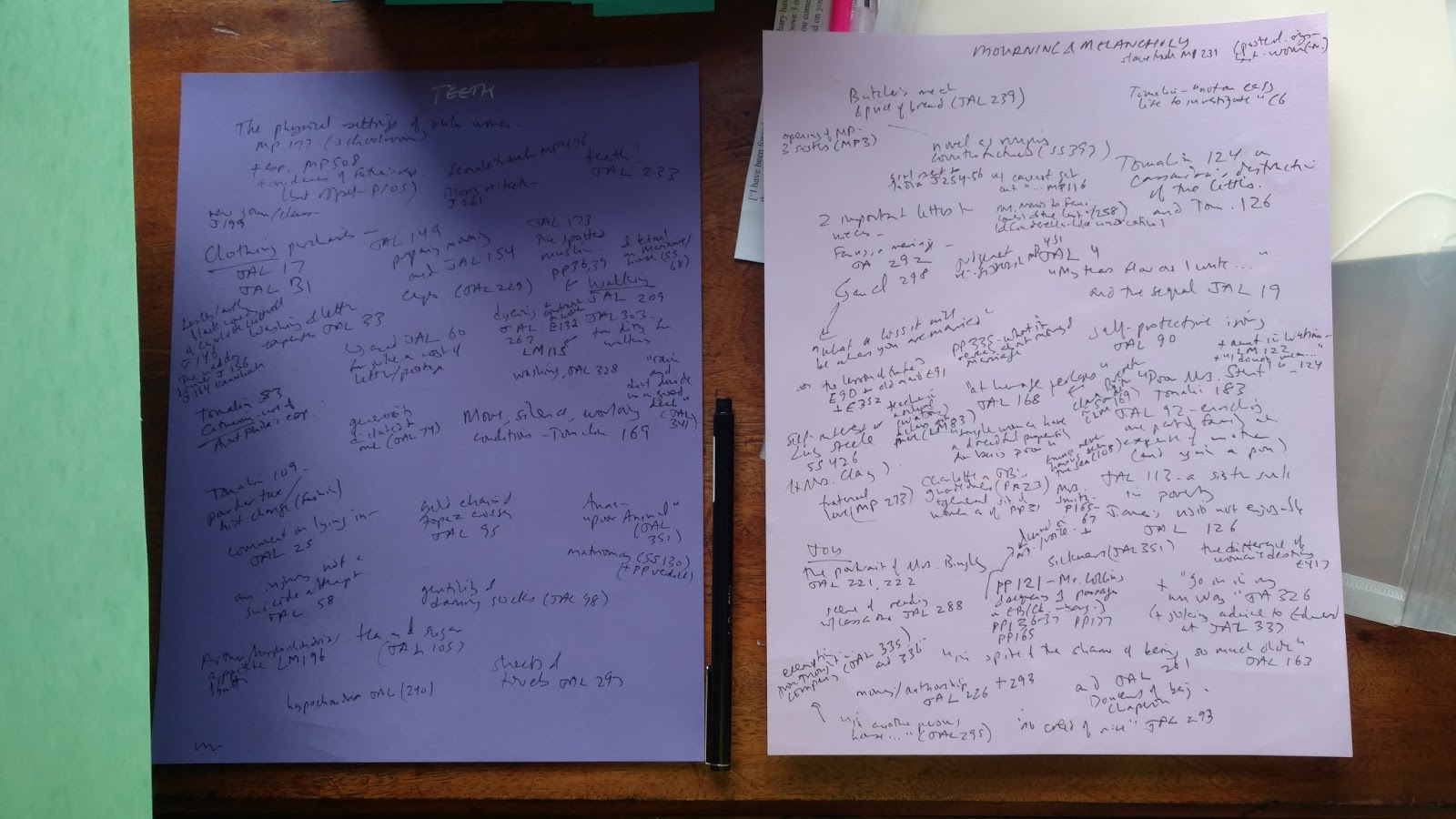
Austen, though! I hate to lose momentum! This is the chart I made once I had had a week of settling in. As I said previously, I don't think I can finish the draft while I'm here, but I should be able to have the book drafted in full (it is a very rough draft) by Xmas.
Going to step up the pace a bit now - I've drafted three chapters (out of eight, but it's possible that seven and eight aren't really two distinct chapters), so I'll press ahead with five days per chapter for the next three, on manners, morals and voice (one day of assembling the notes, four days of producing quota), then type up the notes for the remaining two chapters (teeth, mourning and melancholy) so that I've at least got something on paper.
I'll be doing some reading and library stuff in the meantime, but week 7 will be wholly devoted to footnotology and Bodleian-Weston time and week 8 will involve delivering my two talks, putting finishing touches on the second one (the first is ready to go) and spending some time with Brent, who will come over for that last week.

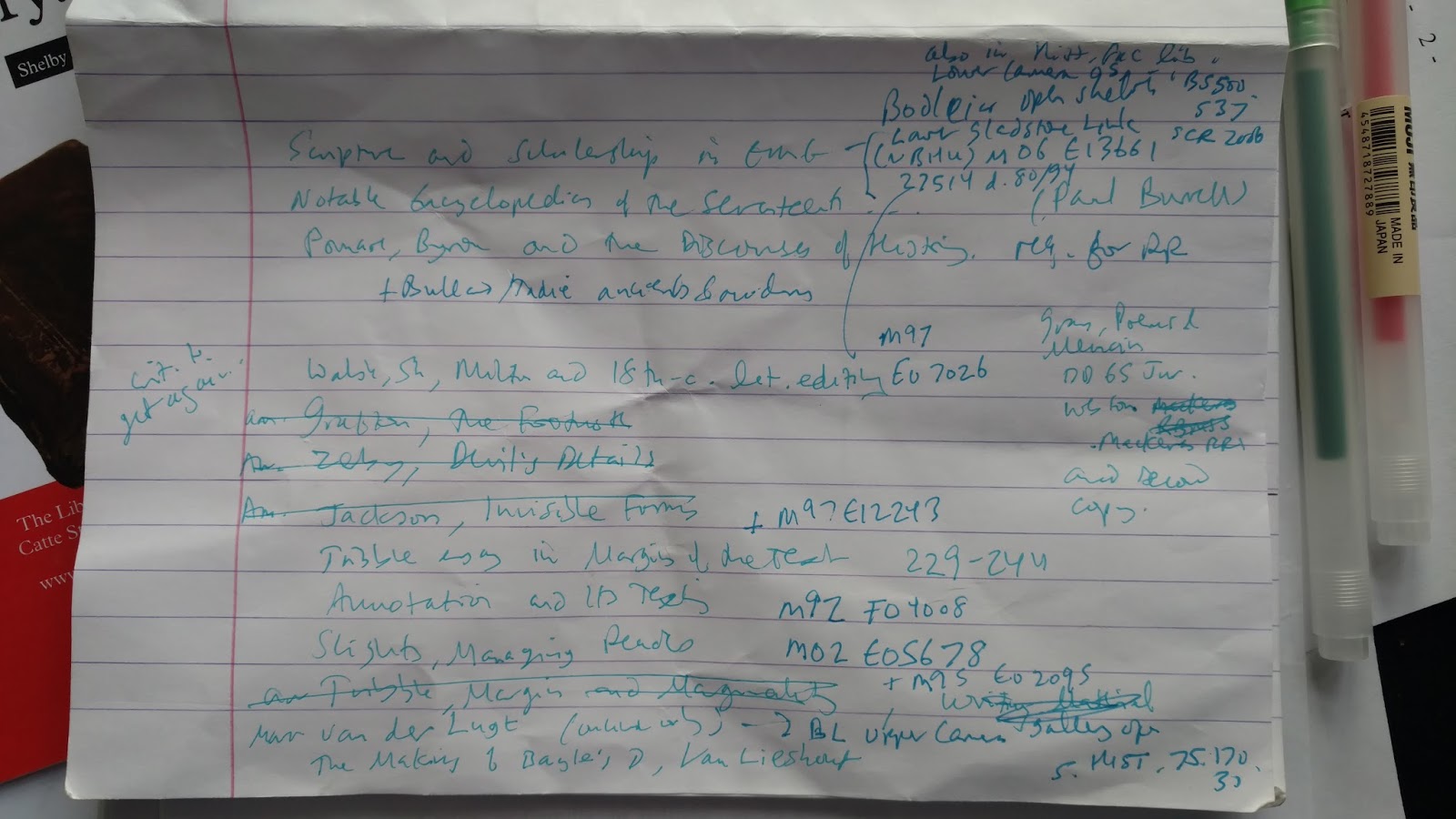
Bonus library method picture. (I do not know that there is better evidence for consistency of character than this - in fact, I wrote about it at least once before on this blog, it was a meme making the rounds in 2005 about what you'd look for in the library in 2015 and I will quote the relevant line here - "Then I would arm myself with a pen and paper (one thing I can guarantee is that in 2015 I will still be jotting down call numbers on the back of an old envelope or a supermarket receipt) and write down a huge long list of call numbers and hit the stacks and then go home for a huge orgy of reading.") (In this case it's on the other side of the piece of paper where I made notes about the new powerlifting warmup sequence!)
The only tricky thing for me work-wise just now is that I'm totally torn between my desire to draft the Austen book as expeditiously as possible (don't want to lose momentum) and my desire to (a) make use of library materials here to do broad reading for footnotology and (b) make progress on Gibbon project and make sure my lecture at the end of term on Gibbon and Gray is really good. I had an amazing evening of Gibbon-related reading last night that culminated in a massive plan and greater clarity: at home in NYC I have a great collection of Gibboniana from the library, but I don't need to reproduce that collection here, I will have access again in December; I do need to reimmerse myself in Gray (requested amazing slew of stuff to read at the Weston in the rare book room); and I do need to pull together at least a mini-footnote library to reimmerse myself and identify crucial primary sources for library investigation, couldn't bring that stuff with me as luggage book space was given over to the Austen volumes. So I've ordered four things from Amazon UK and identified the area of open stacks in the Bodleian where I can find the 10 or so other things I think I really need to have to hand (list can be found at the bottom of this post).
Austen, though! I hate to lose momentum! This is the chart I made once I had had a week of settling in. As I said previously, I don't think I can finish the draft while I'm here, but I should be able to have the book drafted in full (it is a very rough draft) by Xmas.
Going to step up the pace a bit now - I've drafted three chapters (out of eight, but it's possible that seven and eight aren't really two distinct chapters), so I'll press ahead with five days per chapter for the next three, on manners, morals and voice (one day of assembling the notes, four days of producing quota), then type up the notes for the remaining two chapters (teeth, mourning and melancholy) so that I've at least got something on paper.
I'll be doing some reading and library stuff in the meantime, but week 7 will be wholly devoted to footnotology and Bodleian-Weston time and week 8 will involve delivering my two talks, putting finishing touches on the second one (the first is ready to go) and spending some time with Brent, who will come over for that last week.

Bonus library method picture. (I do not know that there is better evidence for consistency of character than this - in fact, I wrote about it at least once before on this blog, it was a meme making the rounds in 2005 about what you'd look for in the library in 2015 and I will quote the relevant line here - "Then I would arm myself with a pen and paper (one thing I can guarantee is that in 2015 I will still be jotting down call numbers on the back of an old envelope or a supermarket receipt) and write down a huge long list of call numbers and hit the stacks and then go home for a huge orgy of reading.") (In this case it's on the other side of the piece of paper where I made notes about the new powerlifting warmup sequence!)
Saturday, October 15, 2016
Saturday evening snippet
End of week 1 (of 8) in Oxford. Really nice week! Though need to buckle down and start working properly - adjustment period is properly coming to a close....
A Saturday evening Gibbon snippet (new title for book is Gibbon's Rome: A Love Story - it is amazing how just sitting quietly and reading allows ideas to flow, I was having insane thoughts last night about how you would write an opera libretto that would bring the juxtaposition of the father-son dynamic, the father marrying and preventing the son from being able to do so - and not sending the money he promised so that Gibbon has to keep his brokeness a shameful secret from the friends he has been traveling with - and then the moment of impact when Gibbon actually meets Rome the city - but in my book, it's my own love story with the Decline and Fall as well):
One of my two talks for the end of term now has an explicit commitment to talk especially about Gray's and Gibbon's footnotes, so I will do some Gray reentry also in between the other footnote reading. Exploration of library system to begin Monday, must first have a proper writing session on Austen and must before that finish typing up notes for the first chapter so that I can proceed to the next stage!
A Saturday evening Gibbon snippet (new title for book is Gibbon's Rome: A Love Story - it is amazing how just sitting quietly and reading allows ideas to flow, I was having insane thoughts last night about how you would write an opera libretto that would bring the juxtaposition of the father-son dynamic, the father marrying and preventing the son from being able to do so - and not sending the money he promised so that Gibbon has to keep his brokeness a shameful secret from the friends he has been traveling with - and then the moment of impact when Gibbon actually meets Rome the city - but in my book, it's my own love story with the Decline and Fall as well):
I owe it to myself, and to historic truth, to declare, that some circumstances in this paragraph are founded only on conjecture and analogy. The stubbornness of our language has sometimes forced me to deviate from the conditional into the indicative mood.Main task for remaining weeks is to draft as much of the Austen book as I can (I'm optimistic that I should be able to get most of it down on paper in at least a rough version, top limit of 50K I think for full book so 8 chapters at 5-6K each should be doable in a 1.5K production of quota fashion); glory in libraries and read massive amounts of general footnote stuff (mostly amazing primary sources, especially history and poetry, with footnotes); and (re)read a chapter a day of Gibbon to put myself in the mood.
One of my two talks for the end of term now has an explicit commitment to talk especially about Gray's and Gibbon's footnotes, so I will do some Gray reentry also in between the other footnote reading. Exploration of library system to begin Monday, must first have a proper writing session on Austen and must before that finish typing up notes for the first chapter so that I can proceed to the next stage!
Monday, August 15, 2016
Conjectural histories
I have completely succumbed, by the way, to the allure of Gibbon. Excited about working on this project! Here are two small bits that may convey some of the quality I find so irresistible in Decline and Fall of the Roman Empire:
On Gordianus, father and son:
Or again, in a more contemplative vein (on the difficulty of writing about the empire c. 248-268 CE):
On Gordianus, father and son:
When he reluctantly accepted the purple, he was above fourscore years old; a last and valuable remains of the happy age of the Antonines, whose virtues he revived in his own conduct, and celebrated in an elegant poem of thirty books. With the venerable proconsul, his son, who had accompanied him into Africa as his lieutenant, was likewise declared emperor. His manners were less pure, but his character was equally amiable with that of his father. Twenty-two acknowledged concubines, and a library of sixty-two thousand volumes, attested the variety of his inclinations; and from the productions which he left behind him, it appears that the former as well as the latter were designed for use rather than for ostentation.(The note to that last sentence reads: "By each of his concubines, the younger Gordian left three or four children. His literary productions, though less numerous, were by no means contemptible.")
Or again, in a more contemplative vein (on the difficulty of writing about the empire c. 248-268 CE):
The confusion of the times, and the scarcity of authentic memorials, oppose equal difficulties to the historian, who attempts to preserve a clear and unbroken thread of narration. Surrounded with imperfect fragments, always concise, often obscure, and sometimes contradictory, he is reduced to collect, to compare, and to conjecture: and though he ought never to place his conjectures in the rank of facts, yet the knowledge of human nature, and of the sure operation of its fierce and unrestrained passions, might, on some occasions, supply the want of historical materials.
Wednesday, June 01, 2016
The transition to summer
Always awkward and more protracted than I would like! But this is the beginning of a full year of sabbatical - I won't be teaching again till September 2017 - and once I get into a groove, it should be pretty idyllic. I'll be based mostly in NYC with frequent trips to Cayman, but I have two really exciting additional places to be.
(And most immediately, I'll be embarking on the "Reading Austen" book and working on a few smaller non-academic bits, including a piece about Jenny Diski. Clarissa project has not been forgotten but is temporarily on the back burner....)
I'll spend the Michaelmas term (early October through early December) as an Oliver Smithies visiting lecturer at Balliol College, Oxford (I'll be working on the literary history of the footnote with special emphasis on Gibbon and history-writing).
And I'll spend six weeks in February and March as Sovern/Columbia Affiliated Fellow at the American Academy in Rome. Here is the project I'll be working on (I'm really excited about this!):
(And most immediately, I'll be embarking on the "Reading Austen" book and working on a few smaller non-academic bits, including a piece about Jenny Diski. Clarissa project has not been forgotten but is temporarily on the back burner....)
I'll spend the Michaelmas term (early October through early December) as an Oliver Smithies visiting lecturer at Balliol College, Oxford (I'll be working on the literary history of the footnote with special emphasis on Gibbon and history-writing).
And I'll spend six weeks in February and March as Sovern/Columbia Affiliated Fellow at the American Academy in Rome. Here is the project I'll be working on (I'm really excited about this!):
“Gibbon’s Rome”
“It was at Rome, on the fifteenth of October 1764,” wrote Edward Gibbon in a draft of his memoirs, “as I sat musing amidst the ruins of the Capitol, while the barefooted friars were singing vespers in the temple of Jupiter, that the idea of writing the decline and fall of the City first started to my mind.” Gibbon’s Decline and Fall of the Roman Empire would expand to treat the long history of the empire as it migrated east, not just the history of the city in which the empire had its origin, and his research took place in libraries, cabinets of medals and so forth in London, Paris, Lausanne and Geneva as well as in the streets of Rome. But the physical landscape of Rome as Gibbon first encountered it in the 1760s provided much of the emotional impetus for the project, and the city figures in the history in a number of different ways.
In “Gibbon’s Rome,” I am proposing a long essay or a short book (probably in the region of 40,000 words) that tells the story of what Gibbon saw in Rome and what it meant to him. I am envisioning a narrative not oriented exclusively towards scholarly readers but written more in the style of something like Mary Beard’s SPQR: A History of Ancient Rome; another model, in a rather different vein, is Geoff Dyer’s Out of Sheer Rage: Wrestling with D. H. Lawrence. The narrative will weave together a number of different strands with the goal of producing a lively narrative history with a literary-critical bent: recounting the series of choices and accidents that led Gibbon to Rome as a place and a topic; reading important passages from some of the works of history that were formative for Gibbon (this is a book about Gibbon’s reading as well as about Gibbon as tourist!) in earlier years and that contributed to the research techniques and evidentiary protocols that underpin Decline and Fall; considering the rise of the Grand Tour as a mode of self-cultivation and development for wealthy young British men over the first half of the eighteenth century; vividly describing the streets and buildings Gibbon walked through, the state they were in during this period and the kinds of collections of artifacts he was able to visit and examine; and of course analyzing and celebrating the language of Decline and Fall. I will draw on visual and journalistic records made by other visitors during the same period in order to bring the setting most powerfully to life.
My goal in this project is not just to recount the history of one historian’s relationship with one city, though that will occupy a good deal of my attention, but also to use the story of Gibbon’s encounter with Rome as a case study that gives us more general insight into how eighteenth-century writers came to understand the relationship between past and present and the tools for narrating and comprehending historical change. The context in which I developed this project involves a longstanding interest in the battle of ancients and moderns as it was worked out in Britain by combative writers like the textual editor Richard Bentley, Jonathan Swift and Alexander Pope, and my large-scale research project for the next few years will be to do the groundwork for an ambitious literary history of the footnote in the long eighteenth century. My interest in the footnote really derives from the fact that, as the scholar Evelyn Tribble has observed in an essay on the history of the transition from marginal annotation to footnotes, the shape of the page often becomes “more than usually visible” at periods when “paradigms for receiving the past are under stress”: “In the early modern period, as models of annotation move from marginal glosses to footnotes, the note becomes the battlefield upon which competing notions of the relationship of authority and tradition, past and present, are fought” (“‘Like a Looking-Glas in the Frame’: From the Marginal Note to the Footnote,” in The Margins of the Text, ed. D. C. Greetham [Ann Arbor: The University of Michigan Press, 1997], 229-244). Gibbon will feature in a chapter of that projected monograph, with the tension between the evidentiary impulse of the notes to the Decline and Fall and their fundamentally skeptical or ironic orientation towards the main narrative providing a starting point for a closer investigation of the footnote in British and French history-writing during this period. But I feel that there’s enough material, in the question of what Gibbon’s monumental history tells us about his own and his contemporaries’ understanding of the relationship between past and present as we comprehend it by way not just of books but by movement through ruins and landscapes and by interaction with historical artifacts, that I’ve made a commitment to pursue this smaller-scale project as a complement to the bigger one.
Six weeks at the American Academy in Rome would provide the ideal setting for some physical exploration of sites and museums alongside time in the library reading some of the narrative histories from which Gibbon took his inspiration as well as modern scholarship on the history of archeology and antiquities in Italy, museums and other viewing sites, other eighteenth- and nineteenth-century British visitors’ accounts of their relationship to the city, practices of historical restoration or reconstruction and so forth. An initial list of authors and books of particular interest to me would include Cicero, Livy’s histories, Erasmus’s Ciceronianus and the associated debate on Latin style, Bayle, Voltaire, Bossuet, le Sueur, de la Bléterie’s Life of Julian and Guischardt’s Mémoires critiques et historiques sur plusieurs points d'antiquités militaires. I would especially love to look closely through the collection of historical maps in the Rare Book Room; serendipity has a large role to play in this sort of project, and there will be no substitute for being physically on-site as I embark upon this research.

Wednesday, October 03, 2012
Reading in bed
A favorite moment from Oliver Sacks's new book:
Once, while reading Gibbon’s autobiography in bed—this was in 1988, when I was thinking and reading a great deal about deaf people and their use of sign language—I found an amazing description by Gibbon of seeing a group of deaf people in London in 1770, immersed in an animated sign discourse. I immediately thought that this would make a wonderful footnote for the book I was writing, but when I came to reread Gibbon’s description, it was not there. I had hallucinated or perhaps dreamt it, in a flash, between two sentences of text.
Subscribe to:
Posts (Atom)