Showing posts with label teaching. Show all posts

Friday, December 17, 2021

Light reading email for my students

 I may yet do a "books I've loved" post, not sure though and thought I'd share this in the meantime.

--

Literary fiction


Garth Greenwell, What Belongs to You and Cleanness


Imbolo Mbue, Behold the Dreamers


Tayari Jones, Silver Sparrow


Ling Ma, Severance


SFF


Natasha Pulley, The Kingdoms


Rebecca Kuang, The Poppy War trilogy (3 novels)


Fonda Lee, The Green Bone trilogy (3 novels)


Tade Thompson, The Rosewater Trilogy (3 novels)


Crime


S. A. Cosby, Blacktop Wasteland


Peter Temple, The Broken Shore


YA


The Marrow Thieves by Cherie Dimaline


The Firekeeper’s Daughter by Angelina Boulley


Garth Nix, The Abhorsen novels (new installment out this fall is Terciel and Elinor)


Romance


Helen Hoang, The Kiss Quotient


Sunday, September 20, 2020

My six months

 We all count it from different days.  My shelter in place really started on Thursday, March 19.  I'd seen it coming - I saw the footage of Wuhan hospitals in late January and it was clear to me it was going to be "the big one" - but that's not the same as being able to envisage the transformations that would ensue.

I hosted a small book party in my apartment on the evening of March 5 - we had the windows open and the fan blowing from the window-unit AC, uneasily bumped elbows and so forth.  Given that community spread was already taking place in my Columbia community (people who'd returned from Italy) we were lucky, I think, that it didn't become a small super-spreader event.

Classes were suspended on the 9th, and Columbia asked employees not to undertake non-essential international travel, but I was hungry to see Brent (it was essential for me!) and I got on a plane to Cayman on the 11th as planned for ten days to overlap with the week-long spring break.  Each day the situation seemed more grave; we went to Fidel Murphy's for early happy hour on Friday as always, and the bar was deserted except for a handful of panicky servers looking at the collapse of St. Patrick's Day prospects and the likelihood that many of them would have to leave the island if shutdowns continued on the planned trajectory.

I wasn't supposed to fly home until the 21st, but on the 17th the Cayman government announced that the border would close on the 22nd; my flight was canceled and I hastened to get on the next flight back to NYC.  I wouldn't have gone to Cayman if it would have been an absolute disaster to get stuck there, but it is not desirable to be where you don't have immigration status and access to your real work materials in a time of pandemic.  Got a business class seat on Cayman Airways and was home late on the 18th.  As I left the apartment the next morning to lay in a few essentials (I'd been stockpiling cat food and toilet paper already before I went to Cayman), I felt something like a membrane stretch across my door, I had to press my way through it, and I saw that it was a very good thing that I run five times a week outside, a non-negotiable commitment for me, or else I would be looking at a serious exacerbation of mild agoraphobia.

I said goodbye to Brent at the airport on March 18.  I thought then that I'd probably be able to get back to Cayman for the summer months, but the borders have remained closed.  There's a soft opening for Oct. 1, but it's still only repatriation flights and you have to book through a government agency: I'm not sure whether or not I would get permission, though at some point I need to try.  We're still hoping to see each other in December, but there are too many variables to make more than a good guess about how and where that will happen.

In almost every respect I have been extremely fortunate through all this.  I have a secure job and can easily work from home.  I like being at home and am not itching to travel, unless I could suddenly be teleported to Brent's condo.  I have two funny cats who are excellent companions!  I've had harder summers.  And yet....

The start of the new school year has brought a sense of movement to my life that was sorely lacking.  Depression has been hovering, but it's mostly lifted (leaving me with acute anxiety, inevitably, but I can work with that). 

It is going to be a meaningful and rewarding year of work, I think, within just about manageable bounds.  I made a choice last winter that now looks prescient: once I realized I was going to be running my pilot Work Inside and Outside the University seminar and also chairing the Arts and Sciences Policy and Planning Committee, I decided to use up a semester of banked course release (I am operating in an extraordinarily privileged realm of academic life) so that I could teach 1-1 rather than 2-2 for 2020-21.  (The work seminar carries through for the whole year, and I was particularly worried about having in effect 3 courses as well as PPC chairing for the spring semester.)

 And this morning I printed out my book manuscript, the version I finished in January and haven't touched since.  I hired a developmental editor in July to give me a detailed edit letter, and she provided me with truly excellent comments and insights.  I had genuinely no wherewithal for it over the summer, all my energy was going towards getting from day to day (running and yoga were good, and so was the writing accountability group I was running every day, but mostly I just huddled in bed doomscrolling), and that didn't contribute to my sense of well-being. I always have a book going!  It may not be realistic to think I'll be able to work on it consistently this semester, but I am at least going to see whether it might be possible to have about forty-five minutes a day for it, five days a week....

Friday, April 17, 2020

Final assignments

Your final assignment, should you choose to accept it, is a 5-7pp. personal critical essay on a topic of your choice. I’ve written this up as a shared set of directions for both of my seminars in case seeing the other class’s essay options helps you think of something you would like to write about. You are welcome to adapt or abandon the questions I’ve written as you see fit.

Reminder: I’d love to see something from you in the way of final writing, but you will receive credit for the class whether or not you hand something in to me.

You’ll upload your assignment to Courseworks and I’ll send you a short email with comments before the end of May. I’ve included these hard deadlines because I don’t want you to feel open-ended stress about writing something for which you may not have the wherewithal, and I intend to submit the roster of Pass grades on May 22, but I’d be delighted to read anything for you in summer months if you find yourself working on a writing project of any kind and would like some feedback.

The term “personal critical essay” is possibly coined by me. It overlaps with the category called “creative nonfiction” and can be found more often on literary websites than in academic journals. These are some of its traits:

- Less formal in tone than an academic essay

- May quote a passage or passages from the reading, but won’t depend on extended close reading work or a fully developed analytic argument

- Personal thoughts and observations are welcome

- Getting your self into your voice on the page is to be desired rather than avoided

- May be structured as associative “musings” and probably won’t include conventional argument transitions

I’m going to share a few examples, though these are all at a higher level of polish and sophistication than I imagine you should shoot for if it’s your first attempt in this mode.

The first one, a lovely short piece for Electric Literature, was actually adapted from the final essay a student wrote for me when I taught the Epic Histories class in Paris – based on specific conversations we’d had about Baudelaire’s “Painter of Modern Life” and the students’ own habits and preferences, I wrote an essay question about what it’s like to visit Sephora in Paris, and got this amazing set of reflections in response: Sarah Anjum Bari on visiting Sephora under the shadow of the Arcades Project (read it here).

And I’ll give you two more links to essays written and published by advanced PhD students in our department:

Liz Bowen’s New Inquiry review of the film A Quiet Place (read it here)

Carina dell Valle Schorske’s Lit Hub essay on Gwendolyn Brooks (read it here)

Finally, an essay that we’re going to read for and talk about during the final meeting of Clarissa: See-Young Chu’s “Woven: A Refuge for Jae-In Doe: Fugues in the Key of English Major,” published in Entropy. This is an upsetting one, and you should make sure you’re fortified for it before reading, especially if reading about sexual assault is triggering for you. You can find it here.

Epic Histories options

Original due date: Monday 5/11

New due date: Monday 5/18

1. Take one of Benjamin’s short chunks of text in the Arcades Project or elsewhere and use it as the epigraph for a personal essay about how we experience history in the time of covid-19.

2. We talked about several stumbling-blocks that made it difficult for Gibbon to write his own autobiography, the two chief ones being the challenge of how to represent a bad father given the bounds of decorum and the difficulty of retroactively defending a tendency towards religious skepticism that looked far more dangerous in the light of revolution in France. If you were going to set out to write your own autobiography, what would be the chief factor that would make it hard for you to tell an honest and fully represented story?

3. We switched from live to online meetings just before we moved on from Gibbon to Benjamin. How is reading the Benjamin of the Arcades Project different from reading Decline and Fall and/or Gibbon’s autobiographies? How is our online conversation different from the face-to-face ones we had for the first half of the semester?

Clarissa options

Original due date: Friday 5/8

New due date: Friday 5/15

1. Given that the novel Clarissa is so concerned with the problem of confinement, what was it like to read Richardson’s book in conditions of quarantine? Alternately, write a letter to a close friend in which you reflect on your current situation in a fashion that includes some thoughts about Richardson’s novel.

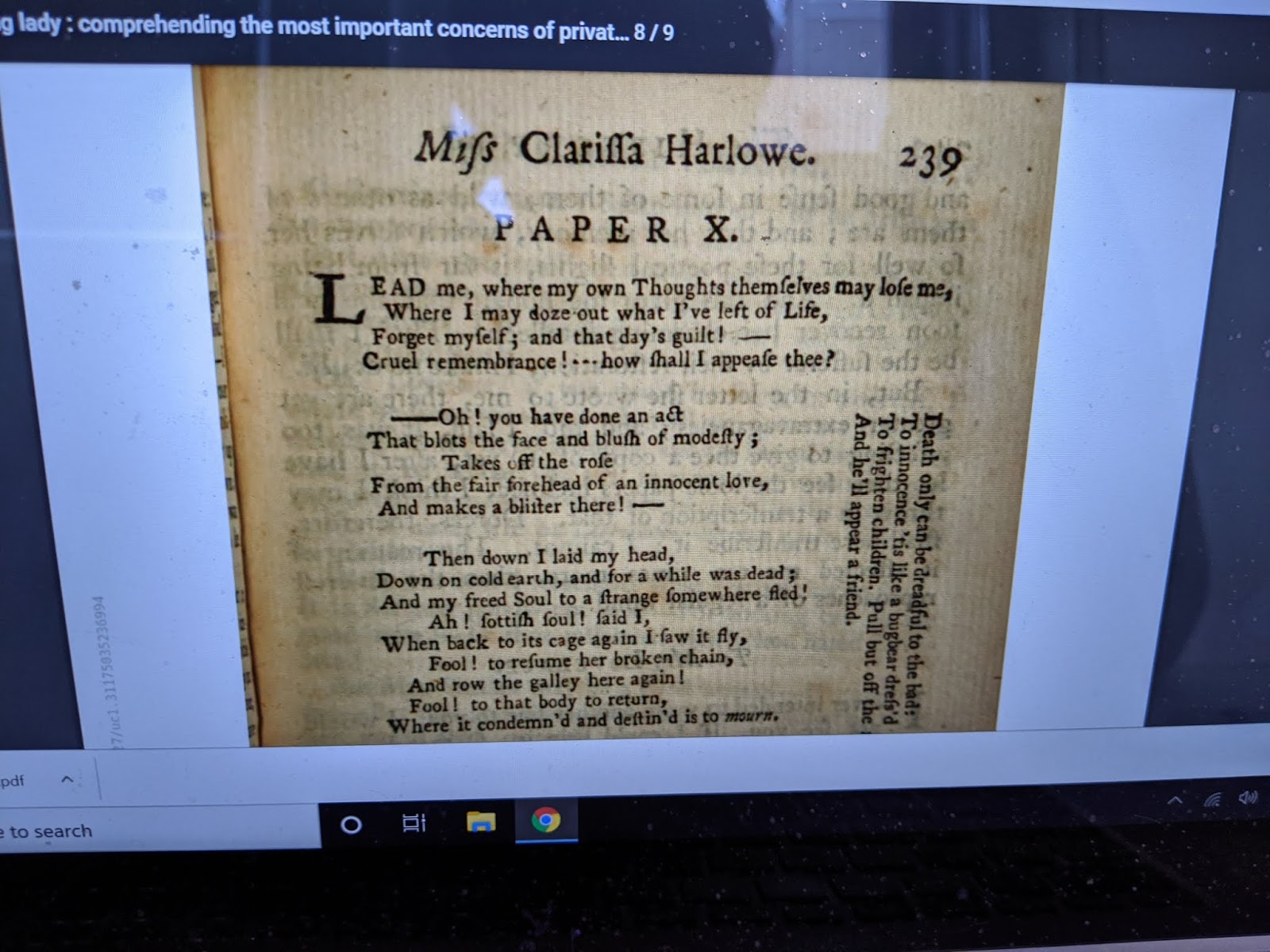
2. We talked about the “mad papers” and looked the typography Richardson the printer was able to use to supplement the textual meanings he created by way of words. Using a mix of visual and verbal methods (this might or might not be an essay!), create a single page layout, analog or digital, that integrates some bits of Clarissa and other texts you’re currently reading into a visual representation of your current state of mind.

3. How does a Columbia literature seminar create community? Is the physical classroom space essential, or do we find ourselves able to approximate many of its virtues on Zoom? If not, why not? How would you frame the virtuality of Zoom communication in terms of eighteenth-century epistolarity?


Tuesday, April 07, 2020

NYC 17-20

Just as in normal times, the ease of posting to Facebook multiple times a day leaches the energy away from the blog! Staying light-hearted over there (lipstick, grilled cheese) so much as it is possible.

My Monday class went well, though 2 of 8 students couldn't be there. We had a riveting discussion of Convolute C of Benjamin's Arcades Project!

Nice Zoom chat this morning with a student in Korea who can't join the Clarissa seminar live but has stayed very involved with the material. She's just declared an English major - joyous news....

Light reading: The Stand, which somehow I don't think I ever read! Was slightly sorry to read the introduction and see that this is King's restoration of a lot of text that was cut from the original. Both as scholar and as reader, I am more interested to see what was initially out in the world (and there have been paragraphs here and there that cause me to speculate, with grim humor, that they simply couldn't - or at least rightly shouldn't - have been in the original published edition!). But yes, it's highly engaging....

More later perhaps, but I thought I'd at least get something down before the day bears down heavily on me.

Oh, and two things that caught my eye yesterday. A good Spec story about the devastating impact on universities like Columbia of the loss of revenue from medical faculty practice. Also, Kate Tulenko's Facebook post, text copied here: "This is from an obstetrician on Long Island. 30% of their asympto[ma]tic pregnant women in labor are COVID Positive. Health workers need to wear a full protective equipment for all patient contact.
“We started testing all patients on L&D a week ago. So far, in our weeks worth of data, 30% of asymptomatic patients tested positive. We are now wearing full PPE on L&D for all patient encounters.”" Sure does seem like one of the clearest indicators I've seen of true viral penetration in this area....

Tuesday, March 31, 2020

NYC day 12-13

I taught Decline and Fall chapters 15 and 16 yesterday (Gibbon's devastating and possibly ill-placed attack on miracles!) and the chunk of Clarissa that includes the mad papers today. Both classes went well, I think (really it is for students to say, not me!). I am very lucky to be teaching small humanities seminars this semester rather than the big introduction to the major lecture I did in the fall - I mean, I'd still basically be, like, "Everybody passes!," but the logistics of trying to look out for students and keep them engaged would have been far more overwhelming.

Monday morning is my Policy and Planning Committee meeting, we were already in a budget crisis before coronavirus and now things are looking grim indeed. Two hours of that and then two hours of teaching in the afternoon left me so tired yesterday evening that I went to bed around 8:30, slept maybe 9-3, then woke wide awake and took advantage of feeling adequately rested to respond to some student emails that I've for some reason been having a very hard time getting to. Did get a couple hours more sleep maybe 5-8, then a mad scramble in the am to get my materials ready for class. I had hoped it would be easy to set up with iPad and laptop as dual monitors, it was not self-evident to the help desk guy either (but they are outsourcing now). Have ordered a monitor that is supposed to arrive Saturday - I can work with what I've got, but if I'm using screen share in a big way it would be helpful to have all the students' faces in gallery view on a separate screen. Toggling today was less clumsy than yesterday but still felt somewhat hapless!

Comfort reading recs #6 and 7: two series that concern the Church of England! The first of course is Trollope's Chronicles of Barsetshire (a must-read for academics in particular, since it seems that the 19th-century cathedral is basically the twin of the 21st-century university - even the character types are the same....). Second, Susan Howatch's Starbridge series and the spinoff St. Benet's books. These are books I can reread over and over....

Sunday, March 29, 2020

NYC day 11

I still need to reread for class tomorrow, but it was a pretty good day. Tidied up the three "real" rooms plus the kitchen in preparation for full-on Zoom work mode and teaching tomorrow. The living-room table is where the work lives when I'm not doing it (the three main piles are for the Epic Histories class, the Clarissa class and Duchess of Angus stuff). I normally sit at my desk in my study with my back to the window, but that's not great for video (backlighting makes face invisible), so I've been sitting on the other side of the desk. Now I've cleared up the stuff in the background (including putting away the massive pile of clean laundry that normally lives on a little white plastic armchair) and set up a standing desk thing to elevate the computer slightly for a more flattering view! Finished reading Clarissa pages for Tuesday but still haven't been able to get to grips with returning emails: usually I'm quite good about this, but they've mounted up and they all seem to require an emotional commitment I can't quite muster.

Comfort reading rec #5 (the third in the trio with Eva Ibbotson and Diana Wynne Jones): Robin McKinley. If you haven't read her at all, Sunshine is a great one to start with (baking, vampires); I do love The Blue Sword and The Hero and the Crown although I agreed when I saw in some old interview that McKinley herself is a bit embarrassed by the first one especially (I think she said "it has a whiff of The Sheihk about it"!); her saddest and darkest book Deerskin might be my favorite of all. All of her books have very good animals in them....

Thursday, March 26, 2020

Epic histories remix

I had a very good concentrated spell of work this morning, the task being to revise the syllabus for my Epic Histories class and get the new information out to students. (I've promised them a digital "packet" as well - a single PDF with all the pages for option 1 - on the grounds that sometimes when things are overwhelming it's easier to just read one thing that you could even open on your phone as opposed to wrangling different books and digital files. Planning to use CamScanner - upgraded today to Pro and am hoping that I will be able combine individual page images into a single file within the app.)

Here's the new version of the rest of the semester. I've cut a few things altogether (Nadar's memoir! Benjamin on photography!) and given a bare-minimum option for those whose concentration is failing them. In going through my old class notes and the pages of the Arcades Project, I kind of fell in love with it all over again....

p.s. I think I got the idea of three different levels from the way you show poses as a progression in a yoga class!

Revised syllabus (spring 2020)

3/30 Option 1:

Decline and Fall 1:446, 1:471-74, 1:518-21, 1:524, 1:576-81
Pocock, “Gibbon and the primitive church,” 50-53, 66-68
Pocock, “Putney, Oxford and the question of English Enlightenment,” 44-46

Option 2:

Option 1 + all of chapter XVI

Option 3: original reading

Decline and Fall chapters XIV-XVI (vol. 1)

*J.G.A. Pocock, “Gibbon and the primitive church,” in History, Religion, and Culture: British Intellectual History 1750-1950, ed. Stefan Collini, Richard Whatmore and Brian Young (Cambridge: Cambridge University Press, 2000), 48-68
*Pocock, “Putney, Oxford and the question of English Enlightenment,” in Barbarism and Religion, vol. 1: The Enlightenments of Edward Gibbon, 1737-1764 (Cambridge: Cambridge University Press, 1999), 13-49
*David Womersley, “Gibbon and the ‘Watchmen of the Holy City’: Revision and Religion in the Decline and Fall,” from Edward Gibbon and Empire, ed. Rosamond McKitterick and Roland Quinault (Cambridge and New York: Cambridge University Press, 1997),190-216
*B. W. Young, “Gibbon, Newman, and the Religious Accuracy of the Historian,” from The Victorian Eighteenth Century: An Intellectual History (Oxford and New York: Oxford University Press, 2007), 70-102

4/6 Arcades: an introduction

Option 1:

Benjamin, “Paris, the Capital of the Nineteenth Century,” 13
Convolute C: epigraph through C6 (82-83), C4 (90-91), C6a,2 + C7,1 (95), 9a,2 (100)
Sieburth, “Benjamin the Scrivener,” 7-11
Johnson, “Passage Work,” 82-84

Option 2:

Option 1 + all of “Paris, the Capital…” and Sieburth

Option 3: original reading

Benjamin, “Paris, the Capital of the Nineteenth Century” (1935) (AP 2-13)
Convolutes A, C and P: “Arcades, Magasins de Nouveautés, Sales Clerks” (AP 31-61), “Ancient Paris, Catacombs, Demolitions, Decline of Paris” (AP 82-100), “The Streets of Paris” (AP 516-526)

*Richard Sieburth, “Benjamin the Scrivener,” Assemblage 6 (1988): 6-23
*Barbara Johnson, “Passage Work,” in Walter Benjamin and The Arcades Project, ed. Beatrice Hanssen (London and New York: Continuum, 2006), 66-86
*“Encounters,” from Peter Buse, Ken Hirschkop, Scott McCracken and Bertrand Taithe, Benjamin’s Arcades: An unGuided tour (Manchester and New York: Manchester University Press, 2005), 1-12

4/13 Baudelaire I

Option 1:

Convolute J: J1,5 (230), J3,2 (233), J3a,1 (234), J41,3 (302), J44,3 (308), J51a,5 (321), J55a,5 (329), facing pages 332-33
Baudelaire, “The Sun”/Le Soleil,” “The Swan”/“Le Cygne”

Option 2:

Option 1 + further reading in Convolute J

Option 3: original reading

Convolute J: “Baudelaire” (228-386)
Baudelaire, “The Painter of Modern Life”

*T. J. Clark, “Should Benjamin Have Read Marx?,” boundary 2 30:1 (2003): 31-49
*Max Pensky, “Tactics of Remembrance: Proust, Surrealism, and the Origin of the Passagenwerk,” in Walter Benjamin and the Demands of History, 164-189

4/20 Baudelaire II

Option 1:

The four spleen poems
Benjamin, “On Some Motifs in Baudelaire,” 182-85
Edgar Allan Poe, “The Man of the Crowd”

Option 2:

Option 1 + Haroutunian 62-67 (not on original syllabus)

Option 3: original reading

*Benjamin, “On Some Motifs in Baudelaire,” from Illuminations (155-200)
Selections from The Flowers of Evil: “To the Reader”/“Au lecteur,” “Correspondences”/“Correspondances,” “A Former Life”/“La vie antérieure,” “The Ideal”/“L’Idéal,” “‘I love you as I love . . .’”/ “‘Je t’adore à l’égal,” “Spleen” 1-IV, “The Taste for Nothingness”/“Le Goût du néant,” “The Sun”/“Le Soleil,” “The Swan”/“Le Cygne,” “To a Woman Passing By”/“A une passante,” “Gaming”/“Le Jeu,” “Meditation”/“Recueillement”

4/27 Baudelaire III

Option 1:

Convolute M: M3a,4 (423), M5,6 (427), M13a,2 (442), M16,3 (446), facing pages 447-48
Convolute m: m2,1 (801-2)
Buck-Morss, “The Flâneur,” 33-43

Option 2:

Add full Buck-Morss

Option 3: original reading

Convolutes M, m: “The Flâneur” (AP 416-455), “Idleness” (AP 800-806)

*Susan Buck-Morss, “The Flâneur, the Sandwichman and the Whore: The Politics of Loitering,” in Walter Benjamin and The Arcades Project, 33-65
*Françoise Meltzer, “Money (La chambre double)” (selections), from Seeing Double: Baudelaire’s Modernity (Chicago and London: University of Chicago Press, 2011), 138-180

5/4 Knowledge, Progress, History

Option 1:

“Theses on the Philosophy of History”: IX (257), XIV (261), XVII (263)
Convolute N: N1,3 (456), N1,10 (458), N1a,8 + N2,1 (460), N3,4 (463), N4,2 + 4,3 (464), N7a,7 (470), N9,6 + N9,8 (473), N9a,6 (474), N10,3 (476), N15,2 (481), N19,2 (487)
Rolleston, “The Politics of Quotation,” 13-17
Arnaldo Momigliano, “Historicism Revisited,” in Essays in Ancient and Modern Historiography (Chicago: University of Chicago Press, 2012), 365-73

Option 2:

Option 1 + all of Convolute N and the “Theses”

Option 3: original reading

Convolute N: “On the Theory of Knowledge, Theory of Progress” (AP 456-488)

*Benjamin, “Theses on the Philosophy of History,” Illuminations (253-64)
*Letter from W. Benjamin to G. Adorno
*James L. Rolleston, “The Politics of Quotation: Walter Benjamin’s Arcades Project,” PMLA 104:1 (Jan. 1989): 13-27
*Stathis Gourgouris, “The Dream-Reality of the Ruin,” in Walter Benjamin and The Arcades Project, 201-24
*“The Angel of History,” from Benjamin’s Arcades: An unGuided tour, 95-104

*Arnaldo Momigliano, “Historicism Revisited,” in Essays in Ancient and Modern Historiography (Chicago: University of Chicago Press, 2012), 365-73

Tuesday, March 24, 2020

NYC day 6

I had good intentions about doing some initial reading recommendations today here, but by the time I finished all the other important things, I was all tuckered out! Tomorrow, I think - I've got Zoom meetings with advisees starting around 3 or so but should have some morning time to do a real post here as well as taking care of one or two more logistical things for next week's classes.

It was a good day for me. I had a lovely 1hr as 1:1 jog-walk in the morning (having had quite serious chronic back pain for the last 3 years I finally figured two major fixes out about a month ago and the fact of running and walking without extreme soreness is really helping my mood). I did some rethinking for my Clarissa seminar (Richardson's million-word-long epistolary novel - one of my two classes semester is dedicated just to reading that book from start to finish) and had a great Zoom conversation with about 2/3 of the students in our normal time slot. The university extended spring break through tomorrow, so we didn't have "real" classes yesterday and today, but it was extremely good for my morale to see those faces and hear about how and where everyone is.

Ordered some hot-weather UV+ protective buffs for when the weather gets warmer. I'm using my winter one as a mask outdoors, for running, walking and errands (and yes, it gets washed after each use), but it's a bit scratchy and these ones will be better once I have them in hand.

Predictions are pretty much useless, but I'm figuring I'm home here like this for at least two months. Fingers crossed that I still get to exercise outside during that period!....

Sunday, May 19, 2019

Pamela Weaponized

The stress of the trip gave me a huge relapse vis-a-vis ongoing lung ailment and precipitated a visit to a doctor who gave me some serious medications. But I was very set on seeing Martin Crimp's Pamela adaptation When We Have Sufficiently Tortured Each Other so that I could write about it, and it was highly worthwhile in the end - my piece has just gone live at The Rambling.

A teaser:
My Pamela, when I teach or write about Richardson’s novel, is the Pamela of resistance. I don’t care whether or not my students read much (any?) of the dreadful parts that follow Pamela’s acceptance of Mr. B’s marriage proposal. I refuse to foreground the fact that Pamela voluntarily marries her would-be rapist, or that the main work (the deluded and delusory work!) of the rest of the novel is retrospectively to redeem all that was violent, coercive, troubling in the relationship between the two. Before that, in the first few hundred pages, Richardson has brilliantly conveyed the moment-by-moment consciousness of a young woman under constant threat from the sexual predator who employs her.

Wednesday, February 10, 2016

#122

These are the days when Birds come back -
A very few - a Bird or two -
To take a backward look.

These are the days when skies resume
The old - old sophistries of June -
A blue and gold mistake.

Oh fraud that cannot cheat the Bee.
Almost thy plausibility
Induces my belief,

Till ranks of seeds their witness bear -
And softly thro' the altered air
Hurries a timid leaf.

Oh sacrament of summer days,
Oh Last Communion in the Haze -
Permit a child to join -

Thy sacred emblems to partake -
Thy consecrated bread to take
And thine immortal wine!

Thursday, December 31, 2015

Copious speaking

From Maggie Nelson, The Argonauts:
Sometimes, when I'm teaching, when I interject a comment without anyone calling on me, without caring that I just spoke a moment before, or when I interrupt someone to redirect the conversation away from an eddy I personally find fruitless, I feel high on the knowledge that I can talk as much as I want to, as quickly as I want to, in any direction that I want to, without anyone overtly rolling her eyes at me or suggesting I go to speech therapy. I'm not saying this is good pedagogy. I am saying that its pleasures run deep.

Thursday, September 10, 2015

Closing tabs

School started!

It's tiring but exhilarating: certainly my favorite time of year. Just teaching one class this semester due to extensive committee responsibilities (interesting ones, not tedious at all): the eighteenth-century novel survey. Defoe's Journal of the Plague Year is up first: this is an incredible book, everyone should read it....

Closing tabs:

Sushicat.

It's on my "bucket list" (I hate that expression, but it's unavoidable!) to publish a book with Graywolf.

A nice interview with the author of The Three-Body Problem.

"Black Chronicles II": photographs of people of color in Victorian England.

Duane Swierczynski on M. Night Shyamalan's latest.

Death of a white alligator.

Sisyphean Funtime! (Via Jonathan L.)

Wish I could be in Dublin to see this.

Colum McCann on the tunnels beneath NYC.

Light reading:

I read so many lightweight novels last week that I experienced a sudden and intense and altogether uncharacteristic revulsion towards all fiction! Individually a number of these were very good, but the cumulative effect was slightly sickening (a-la Double-Stuf Golden Oreos).

Seanan McGuire's new October Daye novel, A Red-Rose Chain (very satisfying installment in good series, though her Mira Grant books are more exactly to my taste);

David Lagercrantz, The Girl in the Spider's Web (very good, certainly up to standard of the original series - probably better than installments 2 and 3);

Zen Cho, Sorcerer to the Crown (enjoyable but light; suffers from the inevitable comparison to Susanna Clarke, and also gives me that feeling - most Regency pastiche does this to me - that Georgette Heyer has a lot to answer for! Naomi Novik was wise to take Patrick O'Brian as her Austen-via influence rather than Heyer for the Temeraire books);

Terry Pratchett's final Discworld installment, The Shepherd's Crown (I think the Tiffany Aching books, together with the "Death" subset of the Discworld books, are really Pratchett's most sublime accomplishments - plus Good Omens of course - some of the recent Discworld books have felt pretty thin/overly ideological [trains! progress!], but I very much enjoyed this one);

Nancy Kress, Yesterday's Kin;

Mary Robinette Kowal, Shades of Milk and Honey (not the author's fault, really, but I know Austen's work too well to enjoy this kind of pastiche - this was the one that tipped me over to feeling that many moons would pass before I would again pick up a fantasy novel set in this period!).

Brief turn to nonfiction: Richard Lloyd Parry's gripping People Who Eat Darkness and also Cintra Wilson's new book, which deserves a post of its own.

Really I can't stay off the fiction for long, though: I very much enjoyed Christopher Barzak's Wonders of the Invisible World, and then of course - red-letter day! - Lee Child's new Jack Reacher novel, Make Me. Wildly implausible of course in all sorts of respects, but I love these books so much, and I thought this was a very good installment: the writing is focused, energetic in a way that not all of the recent books have demonstrated.

Finally, I fulfilled the terms of an old promise to B. - that I would watch all of season I of Orphan Black so that we could watch the second season together (he having correctly assessed it as belonging to the small subset of television that I would particularly enjoy).

Thursday, March 19, 2015

Swagger

A lovely interview with Dorothea Lasky at P&W (via Robert Polito):
I use that word “performance” a lot when discussing teaching, and I really believe that what the teacher is doing is a performance. You are saying that this set of behaviors has some meaning. That’s what you’re doing is a spell as well, and that’s definitely what you’re doing in a poem. A poem asserts: I’ve made this line, and this is going to have some effect on you. Just the act of believing does make it have an effect. For example, in a class, if I am going to get ten oranges and ask students to write a poem, just the fact that a teacher has decreed that as important—it does become important. You have a classroom of students who have not only thought deeply about oranges, you also have a classroom’s worth of poems about oranges. Or if we say that we’re going to read John Donne, then that becomes really important. A whole group of people will see his work in a new way—it wouldn’t have happened otherwise, if the people had simply read him on their own. It may seem arbitrary and specific to the particular teacher, and it is, in a holy way. Every teacher brings their style into the classroom in ways that both crucial and critical and this why we still need real-life teachers, not machines, to teach our students.

Tuesday, December 02, 2014

"'Tis first"

#700, The Poems of Emily Dickinson: Reading Edition, ed. R. W. Franklin:
The Way I read a Letter's - this -
'Tis first - I lock the Door -
And push it with my fingers - next -
For transport it be sure -

And then I go the furthest off
To counteract a knock -
Then draw my little Letter forth
And slowly pick the lock -

Then - glancing narrow, at the Wall -
And narrow at the floor
For firm Conviction of a Mouse
Not exorcised before -

Peruse how infinite I am
To no one that You - know -
And sigh for lack of Heaven - but not
The Heaven God bestow -

Wednesday, November 26, 2014

The writing on the wall

I had fun last night lecturing on Beckett and Adorno: I was having slight qualms about having assigned such a difficult piece, but I think it was worthwhile (you never up your intellectual game if you don't read the really hard stuff sometimes, and it is in my view a genuinely revelatory essay - here's the JSTOR link for "Trying to Understand Endgame" though I'm not sure if that's gated for Columbia users only).

Here's a bit I really like (in an effort to get across the true force of Adorno's point, I was elsewhere in lecture describing the disgusting stretch of track where you wait for the front car of the uptown 1 train at 14th St. - I am not sure why, but it is always full of the most revolting detritus, all sorts of trash in several inches of water - it prompts me to think how glad I am it is not my job to clean it up):
What becomes of the absurd, after the characters of the meaning of existence have been torn down, is no longer a universal--the absurd would then be yet again an idea--but only pathetic details which ridicule conceptuality, a stratum of utensils as in an emergency refuge: ice boxes, lameness, blindness, and unappetizing bodily functions. Everything awaits evacuation.
Next year I really will have to put "The Waste Land" on the syllabus as I am so often alluding to it: will move around "The Death of the Author" and "The Intentional Fallacy" to put with it, and will probably also add "Tradition and the Individual Talent" somewhere although that would be too many different things for one week of class....

Bonus link: most enjoyable Wikipedia entry I came across while checking out a few of the allusions in the Endgame passage I worked through in class (I really had no idea it was a dog biscuit!): "Spratt's medium"!

Also: mene mene! I have a probably annoying habit of asking students to gloss things that might be worthwhile to pursue (the meaning of a word, the substance of an allusion), and it is often difficult to tell in a big lecture course whether it's that students know the answer but are shy about uttering it or whether they genuinely don't know and I should go ahead and say it. I was surprised that "mene mene" and the Rembrandt painting of the scene were not more widely familiar. But it is also clear to me that it's not just that I delve most deeply into things because I am the professor and responsible for the material (it is incumbent on you if you're teaching properly to have really done your utmost to have pursued details in passages you're actually actively reading in class), but that what one editor I worked with a long time ago called my "terrier-like" inability not to try and get to the bottom of things is a good part of the reason that I am a professor in the first place!

(It is idle curiosity, often, but especially given the thematic connection of biscuits, I was reminded of the "empire biscuit" internet rabbit hole I went down after seeing Brave with B. and wondering what exactly those iced biscuits with glace cherries on top actually were. I must confess to having a minor obsession with biscuits. Hmmm, biscuits in literature: that is what I should write for the editor I'd like to work with but have been too busy to think of anything for....)

Happy Thanksgiving to all who celebrate the holiday. I had a funny conversation at the doctor's office the other day with the very nice young man who works at the front desk: he said that a well-intentioned but possibly misguided adult had given a dismaying lecture about Thanksgiving as holiday of genocide to his twin five-year-old nieces, and that while he agreed with the substance of the critique, he thought they were really too young to be given much beyond the fantastical story of Pilgrims and Indians joining together to celebrate....

Sunday, November 23, 2014

Closing tabs

A long-overdue post to close some tabs. I am finally running again this weekend, very slowly, though lungs are still impaired. In work as opposed to lung capacity, though the two may be loosely aligned, I am at the point of the semester where I am barely functioning at 60% capacity - teaching Heart of Midlothian and associated criticism tomorrow just overwhelmed me with a desire to write JEDEDIAH CLEISHBOTHAM on all forms of social media, and I must also, alarmingly, write a lecture on Endgame and Adorno for Tuesday evening!

A wonderful personal assistant from my friend Jill's company Lambent Services helped me clean up my work office so that I have lots of room for NEW PROJECTS (about which more anon at some more leisurely moment probably about a month from now). This service is highly recommended - that office has always been a chaotic and neglected enclave, to the point of functionality being impaired, and I am going to make sure to have regular tune-ups to keep it in good nick.

Liz had an extra ticket to this for Thursday: Black Mountain Songs. Enjoyable, interesting, thought-provoking: I had some pangs of guilt that though I am a dedicated teacher with considerable meta-interest in teaching, I have never (yet) been involved in a really utopian teaching scheme. I wouldn't rule it out, only in reality such things probably happen mostly in summers and I am not sure I would survive year-round teaching! Deep Springs has always interested me as a possibility: now I think they either have gone or about to go co-ed, it might be an actual opportunity?

Other bits of interest:

On founding your own country. (Via I.H.D.)

Helen DeWitt's personal library.

Lottje Sodderland on recovery from a stroke.

The Tingle Alley bear report.

Himalayan marmots! (Via B.) Also, an eagle's view of London.

Slight obsession with this historic food site, especially the ices... (Original link possibly via Teri D.?)

Last but not least, pygmy marmoset loves being brushed with a toothbrush and a short history of the black pug.

I must log the light reading or it will be forever lost in the dim mists of history. It has mostly been a very large number of werewolf-vampire-type novels that I think I will not log individually - Ilona Andrews' Kate Daniels novels, which I thought were really very good (I should not have then read the first couple of the Edge series, they are not so much suited to my taste); Stephen King, Revival (suffered for me in comparison to The Shining and sequel, which I read last year, but certainly worth the time); two crime novels by the Israeli writer D. A. Mishani, The Missing File and A Possibility of Violence, both very much the kind of thing I enjoy reading; a reread of a favorite novel of mine by Diana Wynne Jones, Deep Secret, now happily available for Kindle (this caused me to think I should write a long essay or a short book about her); Heather Abel's fascinating and troubling Gut Instincts, an excellent Kindle Single about celiac and mysterious gut woes (could be paired with Leslie Jamison's Morgellon's essay and Sarah Manguso on illness for an interesting trio); Dorothy Hughes' The Expendable Man; then Patricia Briggs' Mercy Thompson novels en masse (still finishing the last few of these - it is mighty soothing to have such a good flow of high-quality light reading).

Also I remembered during grumpy desperate non-exercising binge of book acquisition that I very much wanted to read my longtime digital correspondent Robert Hudson's second novel, and finally got around to obtaining a copy: it is called The Dazzle, and I enjoyed it hugely. Recommended in particular to readers of Peter Dickinson and good interwar period pastiche, but really it's just very appealing (good use of epistolary format!): I am going to pass it on to my mother now, in confidence that she will enjoy it as much as I did.

Wednesday, November 05, 2014

Wires of underground influence

Teaching Billy Budd next week, I'm excited:
About as much was really known to the Bellipotent's tars of the master-at-arms' career before entering the service as an astronomer knows about a comet's travels prior to its first observable appearance in the sky. The verdict of the sea quidnuncs has been cited only by way of showing what sort of moral impression the man made upon rude uncultivated natures whose conceptions of human wickedness were necessarily of the narrowest, limited to ideas of vulgar rascality--a thief among the swinging hammocks during a night watch, or the man-brokers and land-sharks of the seaports.

It was no gossip, however, but fact that though, as before hinted, Claggart upon his entrance into the navy was, as a novice, assigned to the least honorable section of a man-of-war's crew, embracing the drudgery, he did not long remain there. The superior capacity he immediately evinced, his constitutional sobriety, an ingratiating deference to superiors, together with a peculiar ferreting genius manifested on a singular occasion; all this, capped by a certain austere patriotism, abruptly advanced him to the position of master-at-arms.

Of this maritime chief of police the ship's corporals, so called, were the immediate subordinates, and compliant ones; and this, as is to be noted in some business departments ashore, almost to a degree inconsistent with entire moral volition. His place put various converging wires of underground influence under the chief's control, capable when astutely worked through his understrappers of operating to the mysterious discomfort, if nothing worse, of any of the sea commonalty.

Tuesday, October 28, 2014

Teaching edition

Posting around here has been sparse due to excessive other demands, so I thought I'd just give a glimpse into what I've been up to. Yesterday taught a favorite novel, Amelia Alderson Opie's Adeline Mowbray: or The Mother and Daughter. Today, another really wonderful and underrated novel, William Wells Brown's Clotel: Or, The President's Daughter. (Titling coincidence merely serendipitous - but see Franco Moretti's argument about direct and indirect articles in "Style, Inc."!)

Here's the critical reading assigned in addition to the novel for tonight's lecture (which I am still in the process of writing):

#Ann duCille, “Where in the World is William Wells Brown? Thomas Jefferson, Sally Hemings, and the DNA of African-American Literary History,” American Literary History 12:3 (2000): 443-462
#Jonathan Senchyne, “Bottles of Ink and Reams of Paper: Clotel, Racialization, and the Material Culture of Print,” in Early African American Print Culture, ed. Lara Langer Cohen and Jordan Alexander Stein (Philadelphia: University of Pennsylvania Press, 2012), 140-158
#Saidiya Hartman, “Venus in Two Acts,” Small Axe 26 (2008): 1-14

And here's the assignment students will write for seminar this week. It is the last of four short assignments that they write as they build up to working on a final essay that will include both close reading and critical argument; it is designed to let students practice skills as well as coming to a deeper understanding of the novel itself.

Please write answers to the following questions.

1. One of the critical essays you read for this week offers this overview of critical assessments and interpretations of Clotel:

The runaway slave’s mastery of neoclassical diction, which some see as little more than a flaunting of his educational attainments, is for other readers a subversive deployment of the King’s English to tell the slave’s story. What one critic views as structural chaos, another sees as a creative appropriation of multiple forms – from the oral tradition of the slave narrative to the sentimental emplotments of women’s fiction. Where one sees only the bourgeois pretensions of the black middle class, another finds an “informed use of folklore” that offers an insider’s view of the plantation system[.] (Ann duCille, “Where in the World Is William Wells Brown? Thomas Jefferson, Sally Hemings, and the DNA of African-American Literary History,” American Literary History 12:3 [2000]: 443-462; 456)

a. Make a list of three to five of the novel’s most conspicuous formal or stylistic traits (you can include the three that duCille isolates here, only I would like you to describe them in your own words and in as factual or descriptive a manner as possible).

b. Then offer at least two possible arguments concerning the way each particular trait works in the novel. Make sure that these arguments are formulated so as to satisfy the implicit expectations we have of interpretation: not just what the trait involves or how it works, but also what it’s for or why it matters.

2. Near the end of the essay, duCille writes: “When all is said, done, and disposed of—the borrowing, overplotting, preaching, and propagandizing—the real problem with Clotel lies in the particular slippery nature of Brown’s brand of realism, which both deploys and denies the documentary impulse that drives the reading, if not the writing, of African-American literature” (458).

a. Write a paragraph or two that first paraphrases and then amplifies or illuminates this critical assertion. What does duCille have in mind when she lists borrowing, overplotting, preaching, and propagandizing as crucial elements of Clotel? Give specific examples; you can refer back to your answer to question 1 if you feel you’ve already touched on some of the relevant details.

b. What does it mean to say that this novel’s “brand of realism . . . both deploys and denies the documentary impulse”? Pick that statement apart by explaining what duCille means by “the documentary impulse” and identifying where it can be seen in Brown’s novel – three or four examples will do. Then consider what it means to make a distinction between deployment and denial in this context.

3. One obvious oddity of Brown’s novel is that though it regularly invokes real historical incidents, the timeline/chronology is distorted: there are a number of internal contradictions as well as departures from real historical chronology. What are the effects of these contradictions and anomalies? What do they tell us about the novel’s mode of representation? Offer a thesis and support it with specific examples.

4. Jonathan Senchyne uses the phrase “strategically edits” to describe what one chapter in Clotel does to and with Lydia Maria Child’s story “The Quadroons” (“Bottles of Ink and Reams of Paper: Clotel, Racialization, and the Material Culture of Print,” in Early African American Print Culture, ed. Lara Langer Cohen and Jordan Alexander Stein [Philadelphia: University of Pennsylvania Press, 2012, 140-158; 157). That phrase itself represents a kind of argument about Brown’s fictional practice. Use the phrase “strategically edits” as the jumping-off point for a fuller description of what it means and why it matters when Clotel borrows and adapts another literary text.

5. When I lecture on Clotel on Tuesday evening, I will consider some questions about the advantages and limitations of close reading as a method for getting a grasp on novels. In some ways, Clotel is very different from, say, Emma (it’s more like Paradise Lost in the sense that it would be perverse to read it without considering questions of history and politics). But it remains important, I would say, to attend closely to the novel’s narrative voice. Find a two- to four-sentence stretch that you think can fairly stand in for the novel’s narrative voice more generally. Then write a paragraph characterizing that narrative voice. What do we know about the narrator? What are the predominant traits of the narrative voice? Make sure to consider intellectual, affective (emotional) and political dimensions as well as more narrowly stylistic ones.